The Joke That Changed Everything
At my baby shower, my mother handed me a gift bag. Inside was a tiny, white onesie with bold black letters that read: “Surprise, baby of a disappointment.” She swore up and down that it was just a joke. To keep the peace, I laughed. I played my part. But three months later, when there was loud, aggressive banging at my front door, I realized the absolute truth: that tiny piece of clothing wasn’t just my child’s first outfit. It was my family’s final, damning word on my existence.
But to truly understand how a baby onesie dismantled a family, let me back up.
It was supposed to be a sweet, low-key baby shower. We didn’t want anything extravagant. We had homemade cupcakes, soft pink and cream decorations, and delicate paper flowers that my husband, Adam, had stayed up taping to the wall until two in the morning. In the corner sat a folded gift table and a little chalkboard sign that said, Welcome Baby, written beautifully in my friend Melissa’s handwriting.
Adam stayed up until 2 AM hanging these paper flowers, wanting everything to be perfect.
I remember standing in the living room before everyone arrived, placing one hand on my stomach, looking around, and thinking a very dangerous thought: Maybe this time will be different.
That was always my fatal mistake. I always thought: Maybe this birthday. Maybe this holiday. Maybe this major milestone. Maybe now that I’m pregnant, they will finally soften.
My husband Adam was bustling around with a roll of tape between his teeth, trying to force a balloon garland to obey the laws of physics. He looked tired, happy, and slightly panicked—the exact way good men look when they want everything to be absolutely perfect for the woman they love.
“You okay?” he asked, catching me staring at him.
I forced a smile. “I think so.”
He knew me well enough to hear the lie in my voice, but he didn’t push it. He just walked over, kissed my temple, and whispered, “Whatever happens today, we leave together.” At the time, I thought he meant if I got physically tired. I didn’t realize he meant emotionally. I didn’t realize how desperately I would need those words before we even cut the cake.
The Golden Child and the Unspoken Tension
Guests arrived in cheerful little clusters. My friends came first, instantly making the house feel warm and full of life. Melissa brought her cupcakes. My neighbor brought a beautiful crocheted blanket. Adam’s sister arrived with boxes of diapers and a card that made me tear up before I even broke the seal.
Then, my family arrived.
Instantly, the temperature in the room plummeted. It wasn’t dramatic enough that my friends would necessarily notice, but I felt it. I always felt it.
My mother walked in wearing pearls and a crisp cream blouse, carrying herself as though she had been hired to evaluate the event rather than celebrate it. My father followed closely behind, wearing the same bland, detached expression he wore to every family function. And finally, my sister Rita made her entrance. She wore a floor-length dress that was wildly overdressed for a casual living room shower, but it was perfectly aligned with her lifelong belief that every gathering was merely a stage waiting for her to arrive.
Rita kissed the air near my cheek. “Wow,” she said, her eyes sweeping over the room. “You really leaned into the homemade theme.”
I smiled, because smiling was what I had been trained to do. “Yeah, we wanted it simple.”
“Simple can be nice,” she replied, using a tone that heavily implied simple was just a word people used when they couldn’t afford impressive.
Rita was the golden child. Rita glowed. Rita excelled. Rita’s baby registry had been “tasteful,” and her nursery was “classic.” I, on the other hand, was the oops baby. The late baby. The one who ruined the second act of my parents’ lives. When Rita got into Yale, they threw a dinner party. When I worked three jobs through college and graduated debt-free, they called it “character-building.”
The Gift That Broke the Spell
For a while, the shower was lovely. We played silly games, Adam made everyone laugh, and his mother gave us a framed photo of Adam as a baby, saying she couldn’t wait to meet “whoever this little person decides to be.” That sentence struck a chord deep inside me. Just whoever she decides to be. Not what she owes us. Not who she makes us proud of.
Then came my mother’s turn to give a gift.
She handed me the bag with both hands, a wide, knowing smile on her face. She was practically vibrating with the anticipation of the room’s reaction. I pulled out the white cotton onesie. Size zero to three months.
Black letters across the front: Surprise, baby of a disappointment.
For a moment, the entire room became completely soundless.
For one excruciating second, all sound vanished from the room. It was as if everyone had inhaled at the exact same time and completely forgotten how to exhale. My eyes locked on the words.
I felt my baby roll beneath my ribs, and something inside of me nearly broke clean in half. Then, drawing on decades of survival instincts, I laughed. Big, bright, and convincing.
“Oh my god, Mom,” I said, holding it up like a trophy of comedy. “That’s hilarious. You’ve still got that edgy sense of humor, huh?”
My mother beamed with pride. Rita smirked and chimed in, “Well, you were a surprise.”
Adam did not laugh. His face had gone completely still, possessing that terrifying, quiet fury that kind men get when they are deciding whether or not to start a war in public. I carefully folded the onesie, set it down, and excused myself to the kitchen.
Standing at the sink, running water over my clean hands, I made a quiet, monumental decision. My child would never grow up laughing at cruelty just to keep a room comfortable. My child would not be taught that love required swallowing humiliation.
The Evidence Folder and A New Family Policy
After everyone left, I collapsed on the closet floor and sobbed until it triggered a blinding migraine. Adam sat on the floor right beside me, holding my hand, offering no unsolicited advice—just his steady presence.
“Do you think they’re going to treat our baby like me?” I finally whispered.
His face hardened. “Not if we don’t let them.”
That night, I opened my laptop and typed out a document titled: New Family Policy. It was a strict list of boundaries. No jokes at my expense. No uninvited visits. No financial help (I had been subsidizing my parents’ mortgage and my sister’s lifestyle for years). No guilt-based exceptions.
I put the onesie in a zip-top bag and placed it into a physical folder that Adam later dubbed my “emotional insurance policy.” I called it Evidence.
The Birth and the Boundary
When our daughter, Lily, was born, we didn’t tell them right away. The morning after she arrived, my phone buzzed with a text from my mother: Well, is she here or not? No congratulations. No asking if we were healthy. Just a demand for information.
Later, they sent a card to the hospital addressed only to Adam. Inside was a $20 gift card and a sticky note from my mother: Maybe this will help. Hope you can find better work soon. (They had always despised that Adam was a first-grade teacher, mistaking his kindness for a lack of ambition).
In that quiet hospital room, we decided not to let the toxicity in. We went home without telling them.
We went home and told them nothing. We moved to a new rental two towns over. When I finally cut off the $600 monthly mortgage transfer I had been sending my parents, the absolute chaos began. Within 48 hours, my mother was using burner numbers to ask where the money was. My father left threatening voicemails. Rita emailed demanding money for her daughter’s expenses.
Then, the retaliation escalated. Someone made an anonymous report to Adam’s school claiming he was “unstable” and “dangerous around children.” The school had to investigate. Adam was cleared, of course, but the line had been crossed. They were actively trying to destroy my husband’s career and our newborn’s financial stability because I closed my wallet.
I hired a lawyer. Marjorie Bell helped me send out formal cease and desist letters. We changed pediatricians, updated emergency contacts, put passwords on all medical files, and installed a heavy-duty doorbell camera.
The Final Stand on the Porch
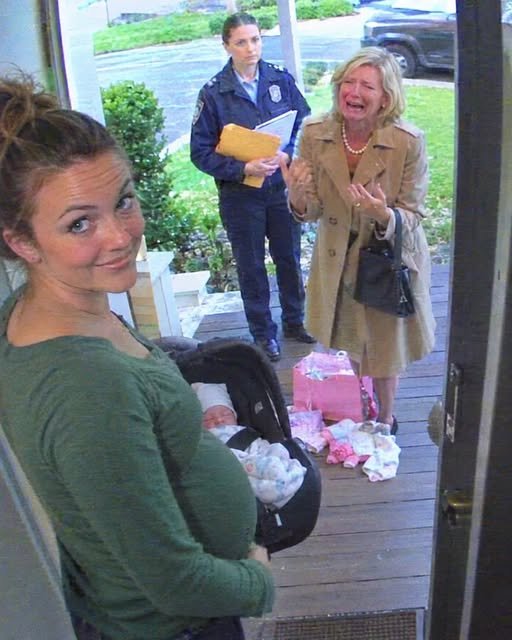
Three months later, the banging started. It was hard enough to rattle the doorframe. I checked the camera. My mother was standing on my porch, weeping performative tears, accompanied by a man in a cheap suit holding a clipboard—a debt collector.
“Christine! Open the door. We need to talk. We’re family!” she sobbed.
I stood behind the locked door, looking through the side glass. “I didn’t do this to you,” I said clearly. “You did.”
The mask slipped instantly. Her sobbing stopped. Her face twisted with rage. “You ungrateful girl,” she hissed, screaming about everything they had supposedly done for me.
I closed the blinds and walked away. That was the last time I ever engaged with her. I sent a message to the extended family explaining exactly why we walked away, complete with screenshots of the financial exploitation, the cruel texts, and a photo of the onesie. I let the facts speak for themselves. The silence that followed was entirely different; people were finally seeing the truth.
Building Our Own Table
By the time Lily turned one, our lives were unrecognizable in the best way possible. We had a small birthday picnic in the backyard with safe people—Adam’s family, my loyal friends, an aunt who apologized for her past silence, and a lovely neighbor who became a surrogate grandmother to Lily.
Peace is sometimes born from painful boundaries, but the light on the other side is beautiful.
I still keep the onesie in an archival box in my closet. I don’t look at it often, but I keep it because old patterns are seductive. They try to sneak back in, wearing softer clothes, whispering things like, “But she’s your mother.” When that happens, I remember what real family looks like. It looks like Adam making coffee at dawn. It looks like friends folding tiny clothes on my couch. It looks like a birthday party where my child’s existence is celebrated, not treated as a punchline.
When people ask if I went too far by cutting my family off, I think about Lily laughing in the morning light. I am absolutely certain that love is meant to be warm. It shouldn’t come with a price tag, an insult, or a required performance.
I didn’t go too far. I went exactly far enough. Far enough to break the joke, end the debt, and ensure my daughter’s first lesson about love didn’t come from people who confuse humiliation with humor. I am not a disappointment. I am a mother. And I finally understand that protecting your peace is not the same as destroying your family—sometimes, it’s the only way to build the first real one you’ve ever had.
Note:This work is inspired by real events and people, but it has been fictionalized for creative purposes. Names, characters, and details have been changed to protect privacy and enhance the narrative. Any resemblance to actual persons, living or dead, or actual events is purely coincidental and not intended by the author.
All images used in this article are AI-generated and intended for illustrative purposes only.