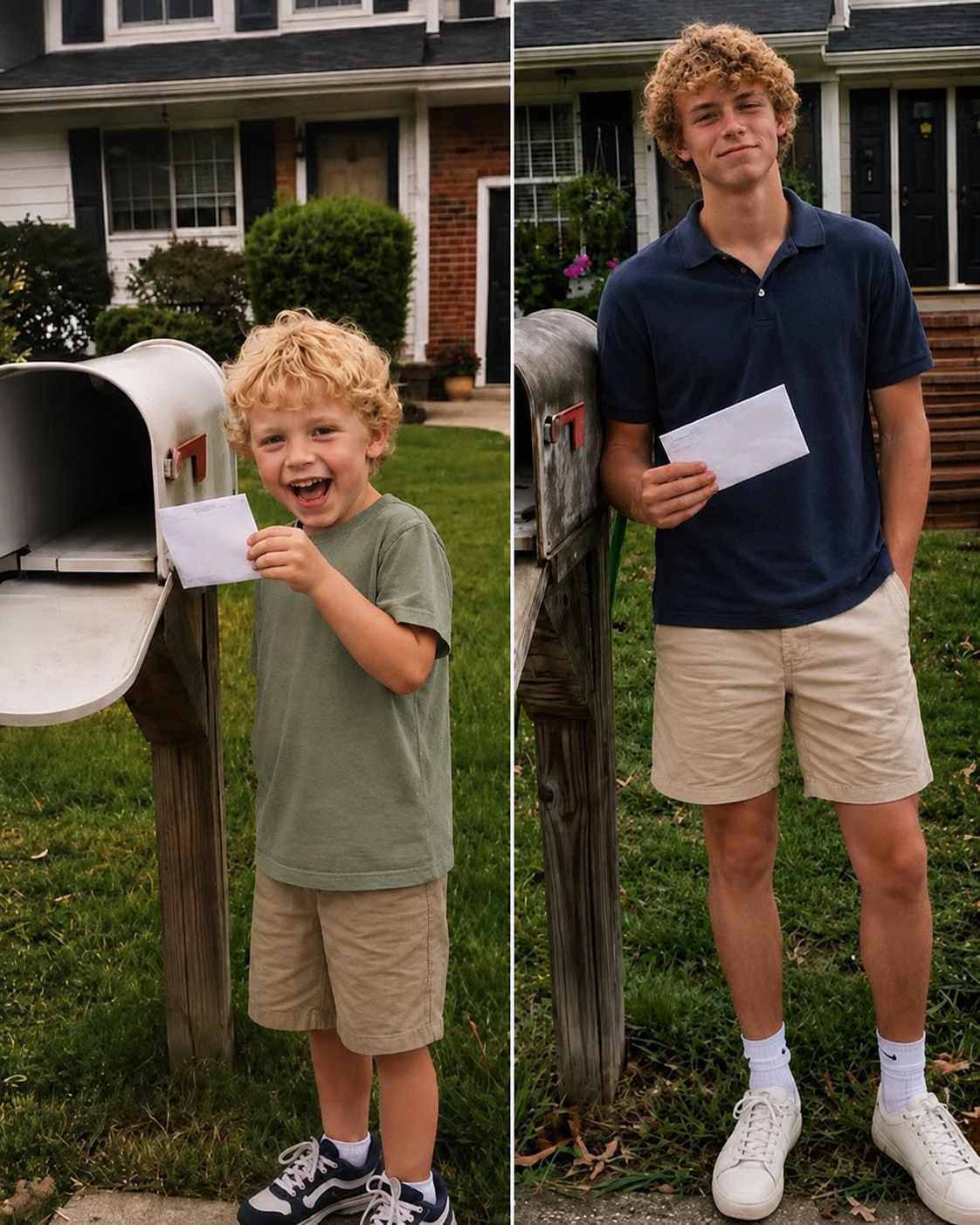
For twelve years, a mysterious envelope arrived for my son on his birthday.
Every year, there was a card.
Sometimes there was five dollars. Sometimes ten. Once, there was even twenty.
But there was never a name.
No return address. No explanation. No clue about who was sending them.
My son, Adrian, loved the mystery.
I hated it.
The first envelope arrived when Adrian turned six.
It was completely ordinary—a plain white envelope with our address written neatly across the front. Inside was a simple birthday card with a cartoon balloon and five dollars folded perfectly inside.
There was no message.
No signature.
Nothing that told us who had sent it.
At the time, I didn’t think much of it.
I was a single mother trying to keep the bills paid and food in the refrigerator. I didn’t have the time or energy to investigate a five-dollar birthday card.
Then the same thing happened the next year.
And the year after that.
By the third year, Adrian was completely fascinated.
“Mom, check the mailbox!”
“It’s seven in the morning,” I told him.
“What if it came early?”
“Mail doesn’t work like that.”
He grinned.
“But what if mystery mail does?”
I can still picture him standing on his tiptoes near the window, watching for the mail truck.
He wasn’t waiting for his presents.
He wasn’t thinking about his birthday cake.
He was waiting for that envelope.
And somehow, every year, it came.
Sometimes it held five dollars. Sometimes ten. When Adrian turned eleven, there was a twenty-dollar bill inside.
He stared at it with wide eyes.
“Okay,” he said seriously. “My mystery person is getting richer.”
I laughed, but by then, the mystery had started bothering me too.
I checked the postmarks.
I studied the handwriting.
I held envelopes up to the light like I was investigating a crime.
I asked my mother.
I asked my sister.
I even called an old friend and joked, “If you’re the person sending my son birthday money every year, just admit it.”
Nobody knew anything.
Or at least, nobody admitted to knowing anything.
Adrian thought the mystery was wonderful.
I thought it was strange.
It never felt threatening. In fact, it felt almost kind.
Someone remembered my son every single year.
But whoever it was wanted to remain completely invisible.
When Adrian turned thirteen, he opened his birthday envelope at the kitchen table while I was making pancakes.
He looked at the card, then suddenly looked at me.
“Mom?”
“Yeah?”
“Are you doing this?”
I laughed.
“Doing what?”
“These cards. Every year. Are you secretly sending them?”
“I don’t think I have that kind of dedication.”
He smiled, but then his expression changed.
“Could it be Dad?”
That question caught me completely off guard.
Adrian’s father had disappeared before his son ever had the chance to know him.
He had never met Adrian.
Never sent a birthday present.
Never asked for a photograph.
There were times when I wasn’t even sure he remembered where we lived—or whether he remembered me at all.
So I told Adrian the truth.
“Your dad doesn’t even know where we live.”
His face fell.
I immediately regretted saying it so bluntly.
“Maybe it’s an old teacher,” I added. “Or one of my friends. Maybe you’re secretly involved in some kind of spy operation.”
That made him smile.
Then I made a joke I’ll always remember.
“Besides, whoever sends these cards actually includes money. Your father would never do that.”
Adrian laughed.
But only for a moment.
Then he looked down at the card again.
After that, we stopped trying to solve the mystery.
The envelope simply became part of his birthday.
Like the cake.
Like the photographs.
Like watching my little boy grow a little taller every year.
Then Adrian turned eighteen.
And something about that birthday felt different.
Maybe it was because eighteen sounded so final.
He was legally an adult.
A new chapter was beginning.
The night before, I stood in the kitchen decorating the cake he’d requested. He told me not to make it “too emotional,” which of course made me even more emotional.
The next morning, the envelope arrived.
Same plain white paper.
Same careful handwriting.
Adrian saw it on the kitchen table and smiled.
“There it is.”
He picked it up.
“Go ahead,” I said.
He looked at me.
“You sound nervous.”
“I’m always nervous.”
“About my birthday card?”
“About everything. I raised you.”
He laughed and opened the envelope.
He pulled out the birthday card.
Then he pulled out something else.
A letter.
I froze.
There had never been a letter before.
Adrian unfolded it.
Within seconds, the smile disappeared from his face.
“Adrian?”
He read it once.
Then again.
“What’s wrong?”
He looked at me.
“Mom… I think I know who sent these.”
My heart started pounding.
“Who?”
He pointed to the bottom of the page.
“It’s signed.”
“By who?”
He swallowed.
“Thomas.”
The name meant nothing to me.
I held out my hand.
He gave me the letter.
It said:
Adrian,
If you’re reading this, you’re eighteen now. I’ve kept my promise for exactly as long as I was supposed to.
Happy birthday.
I owe you the truth, or at least enough of it for you to decide whether you want to know more.
Please visit Merrick and Rowe on Fulton Street and ask for the envelope left in your name. They were instructed to give it to you when you became an adult.
You don’t know me the way you may think you do. But I knew someone who loved you very deeply.
I hope these birthday cards helped you feel remembered.
Take care of yourself, son.
Thomas
I read it twice.
Then I looked at Adrian.
“Do you think it’s your father?”
He shook his head.
“I don’t know.”
But I knew exactly what he was thinking.
An anonymous man.
Twelve years of birthday cards.
A letter waiting at a law office.
And the words “son.”
It sounded like the kind of dramatic move an absent father might make after eighteen years of guilt.
I felt angry just thinking about it.
“He has a lot of nerve,” I said.
Adrian looked at me.
“What if it really is him?”
I didn’t have an answer.
So I gave him the only answer that mattered.
“Then we’ll find out together.”
That afternoon, we drove downtown.
The entire drive was filled with nervous questions.
“What if he’s dead?”
“He signed the letter.”
“That doesn’t mean he signed it recently.”
“What if he wants to meet me?”
“Then you’ll decide whether you want to meet him.”
“What would you do?”
The honest answer was that I would shut the door in his face.
But this wasn’t my life.
It was Adrian’s.
So I said, “I’d find out the truth first.”
The law office was on the second floor of an old brick building.
A receptionist asked Adrian for his name.
She typed something into the computer.
Then she disappeared into the back.
A few minutes later, she returned carrying a large sealed envelope.
His name was written across the front.
My heart started racing.
“Would you like a private room?” she asked.
I looked at her.
“Why?”
She hesitated.
“Mr. Merrick thought you might.”
That answer made me even more nervous.
We followed her into a small conference room.
Adrian sat down.
I stayed standing.
He opened the envelope.
Inside was another, older envelope.
Several letters.
And a typed note.
Adrian began reading.
Mr. Adrian Walker,
Enclosed are personal letters intended for you upon your eighteenth birthday. They were left years ago by my late client, Harold Walker. Mr. Thomas Bell handled the annual cards and gifts at your grandfather’s request.
Sincerely,
James Merrick
Adrian stared at the page.
“My grandfather?”
I couldn’t speak.
Harold Walker.
My father.
My dad had died of cancer when Adrian was still a baby.
He had been very sick at the end, but even then, he asked me about Adrian every day.
“How’s my boy?”
That was always his question.
Adrian never really got the chance to know him.
He had a few photographs.
A handful of stories.
And a wooden toy truck my father had made for him before he became too weak to finish the rest.
Now, suddenly, there were letters.
Letters written by my father.
Adrian opened the first one.
The handwriting was unmistakable.
He began reading aloud.
“If you’re reading this, kiddo, then I missed more of your life than I ever wanted to.”
“I’m sorry for that.”
He stopped.
Then continued.
“Your mother is stronger than she realizes. One day, you will understand that.”
“She carried you before you were born, and she’ll keep carrying you in ways you’ll probably never notice.”
“I hate leaving her to do this without me.”
I covered my mouth.
Adrian continued reading.
“I asked my friend Thomas to help me with something after I’m gone.”
“I want you to have one small reminder every year that someone is thinking about you.”
“Not enough money to spoil you.”
“Just enough so that, on your birthday, no matter what life is throwing at you, you know you’re remembered.”
Adrian’s voice began to shake.
My father’s letter continued.
“I already know I won’t get to watch you grow up.”
“I won’t see your school pictures.”
“I won’t celebrate your birthdays.”
“And one day, you may wonder who is still in your corner.”
“I can’t bear the thought of you feeling forgotten.”
“So Thomas agreed to send you a birthday card every year on my behalf.”
“The money isn’t important.”
“The remembering is.”
Adrian stopped reading.
He wiped his eyes.
I was crying too.
There were several more letters.
In one, my father described Adrian as a baby who frowned in his sleep “like he’s already disappointed in the world.”
In another, he wrote about me.
“Don’t judge your mother by her worst days.”
“She loves with everything she has.”
Then came the final letter.
His handwriting was shaky.
“I’ve asked Thomas not to tell your mother about this.”
“Not because I want secrets between you.”
“She already has enough grief to carry.”
“I don’t want every birthday card to become another reminder of what she’s lost.”
“Let this remain simple.”
“Let it be kindness.”
“By the time you learn the truth, I hope the mystery has made you smile.”
“And I hope your mother has laughed more than she has cried.”
“Love doesn’t always disappear when a person does.”
Adrian lowered the letter.
Neither of us spoke.
For twelve years, I had wondered who was sending those cards.
I had imagined strangers.
I had imagined his father.
I had imagined every possibility except the truth.
It had been my father all along.
Or rather, my father’s love.
And Thomas had simply kept his promise.
Adrian wiped his face.
“So Thomas isn’t my father.”
I laughed through my tears.
“No, honey.”
“He’s Grandpa’s friend.”
Then I remembered.
“Tom Bell.”
I leaned back.
“Oh my goodness.”
“What?”
“Tom used to come to our house all the time when I was little. He and your grandfather went fishing together. He wore those terrible brown suspenders.”
Adrian smiled.
“And you forgot him?”
“I forgot a lot after your grandfather died.”
That was the truth.
Grief had blurred so many memories.
I had been pregnant, terrified, and then suddenly I was a mother trying to survive on my own.
Years passed.
Some memories faded.
Some names disappeared.
But Thomas had never forgotten his promise.
A few minutes later, Mr. Merrick returned.
“I’m sorry to interrupt,” he said. “Thomas passed away about six months ago.”
Adrian looked up.
“He died?”
The lawyer nodded.
“He came here personally before that. He wanted to make absolutely certain the final letter was delivered.”
I asked the question that had been sitting inside me.
“Why didn’t he tell me?”
Mr. Merrick took a breath.
“Your father was very specific. He believed the cards would mean more if they were simply kindness. He didn’t want your son spending every birthday mourning someone he barely remembered.”
That sounded exactly like my father.
Then the lawyer said something I’ll never forget.
“Thomas once told me, ‘I was only holding the ladder steady for a friend.'”
That sentence broke me.
When we got back to the car, neither of us started the engine.
Adrian sat quietly with the letters in his lap.
After a while, he asked:
“Mom… did Grandpa really think I’d feel forgotten?”
I looked at him.
“I think he was afraid of what he’d be leaving behind.”
Adrian stared through the windshield.
“For years, I hoped Dad was sending the cards.”
“I know.”
“I feel kind of stupid now.”
“You’re not stupid.”
He was quiet for a moment.
“Sometimes I really wanted it to be him.”
My heart hurt.
Not because I was angry.
Because I understood.
Children grow up around empty spaces.
And sometimes they spend years hoping someone will come back and fill them.
“I understand,” I told him.
He looked down at the letters.
“But this is better.”
“Why?”
“Because someone who actually loved me remembered me every single year.”
We drove home with the letters between us.
That night, we spread everything across the kitchen table.
The same table where Adrian had opened those birthday cards for twelve years.
The same table where he’d asked if I was secretly sending them.
The same table where he’d wondered if his father was behind the mystery.
Now we finally knew.
There was one last note inside the envelope.
Adrian hadn’t noticed it earlier.
It read:
Harold asked me to stop after your eighteenth birthday. He said that by then, you would be a grown man and wouldn’t need a mystery to know you were loved.
I don’t know if he was completely right.
But I do know this: he talked about you constantly before you could even talk back.
You were loved before you were born.
And you were loved every year afterward.
Happy birthday, Adrian.
Tom
Adrian read it twice.
Then he handed it to me.
“He sounds like Grandpa.”
“He was exactly Grandpa’s kind of person.”
Adrian smiled.
“Stubborn?”
“Very.”
He laughed softly.
“Sounds familiar.”
That night, after the cake was half gone and we’d cried until there were no tears left, Adrian asked me one more question.
“Do you think Grandpa would be upset that you never knew?”
I shook my head.
“No. I think he’d be relieved that his plan worked.”
Adrian looked at the old birthday cards.
“I used to think the mystery was the best part.”
“What do you think now?”
He looked at me.
His eyes were red, but there was something different in his expression.
Something grown-up.
“The best part is that he found a way to stay.”
I couldn’t think of anything better to say.
So I told him the truth.
“Me too.”
For twelve years, I thought an anonymous stranger was reaching into my son’s life.
I wondered if it was guilt.
Regret.
Maybe even his absent father’s attempt to buy forgiveness one birthday card at a time.
I was wrong.
It wasn’t guilt.
It wasn’t regret.
It was love.
Quiet love.
Patient love.
The kind of love that doesn’t need credit.
The kind that keeps a promise even when nobody is watching.
The kind that understands that sometimes a child doesn’t need a grand gesture.
Sometimes, they simply need to know they’re remembered.
The next day, Adrian carried all twelve years of birthday cards upstairs.
I stood in his doorway.
“You’re officially an adult now,” I said. “So I suppose I can start embarrassing you in a more respectable way.”
He rolled his eyes.
“Please don’t ruin the emotional moment.”
I laughed.
“Too late.”
He looked down at the stack of cards.
“I’m going to frame one.”
“One of the birthday cards?”
He shook his head.
“No.”
He tapped the first letter from my father.
“Grandpa’s letter.”
My eyes filled with tears again.
Before I could leave, Adrian called after me.
“Mom?”
“Yes?”
“Thank you for coming with me.”
I smiled.
“Always.”
Because that’s what family does.
We show up.
Even when the truth hurts.
Even when the past surprises us.
And sometimes, even after someone is gone, the love they left behind finds a way to show up too.