Every birthday since he was five years old, my son had planted a white lily for the twin sister who died at birth.
It had become his quiet, sacred tradition—his unspoken way of staying connected to someone he had never truly known. While other kids celebrated another year of growing taller, Logan measured his life in the quiet growth of green stems and porcelain-white petals. But on the morning of his fifteenth birthday, everything we built on that gentle memory fractured into pieces.
Logan ran into the house screaming, his voice trembling with a terror I had never heard before.
Every single bloom in Lily’s Garden had been deliberately cut down. And resting in the exact center of the ruined patch of earth sat an unfamiliar black box with his name written across the lid.
When I read the note taped to the surface, the floor beneath my feet seemed to dissolve. In a matter of seconds, everything I thought I knew about the day my twins were born suddenly felt like a devastating lie.
The Garden by the Porch
The evening before Logan turned fifteen, the summer heat was just beginning to break. I stepped out onto the front porch with a glass of iced tea to find him standing barefoot in the grass, the green garden hose coiled around his ankles like a sleeping snake. The sun was slipping behind the tall oak trees at the edge of our yard, casting long, amber shadows across the lawn.
“You’re drowning them, honey,” I called out gently, leaning against the wooden railing.
Logan glanced over his shoulder, a lock of unruly light-brown hair falling across his forehead. “I’m watering them, Mom.”
“There’s a very fine line between hydration and an accidental flood.”
“According to you,” he teased, a lopsided grin touching his lips.
“According to the plants,” I replied.
He chuckled softly and lowered the nozzle, letting the mist settle like dew over the leaves. That little patch of white lilies beside our front steps was more than just landscaping—it was the emotional cornerstone of our home. There were ten mature plants rooted there now, one added every June since Logan was old enough to realize that his twin sister hadn’t been given the chance to celebrate a single milestone.
I still remembered the afternoon the idea was born. Logan had been five, sitting on the kitchen counter swinging his little sneakers while watching me frost cupcakes. Out of nowhere, he had looked up with wide, serious eyes and asked, “Mom, if Lily can’t have birthdays with us, can we grow her flowers instead?”
I had managed a brave smile, told him it was the most beautiful idea in the world, and then locked myself in the bathroom to weep where he couldn’t see me.
From that summer onward, every single birthday began with a trip to the nursery. Logan guarded those flowers with a fierce devotion. Neighborhood kids could kick soccer balls onto our grass, stray cats could wander through the bushes, and neighborhood dogs could sniff along the fence line—none of it bothered him. But if anyone so much as brushed a fingertip against Lily’s lilies, Logan immediately turned into a sentry protecting hallowed ground.
There was only one annual exception: their birthday.
Every year on June 14th, Logan would carefully select the single most radiant bloom, snip the stem with garden shears, and carry it to the cemetery to lay beside the small granite headstone bearing her name.
That evening, one particularly tall blossom had already begun unfurling its velvety white petals to the evening air. Logan knelt in the dirt, his thumb brushing the outer curve of the bud. “That’s tomorrow’s,” he murmured.
The screen door squeaked behind me. Alex stepped onto the porch carrying an unopened bag of charcoal for tomorrow’s cookout. He came to a halt beside me, looking down at our son.
“We know, buddy,” Alex said quietly.
Logan kept his gaze locked on the opening flower. Then, with an unusual melancholy in his voice, he spoke. “It’s weird being somebody’s twin when you’ve never actually met them.”
I felt Alex stiffen beside me. His hands shifted around the thick paper of the charcoal bag, the paper crinkling sharply under his grip.
“Everyone always says ‘your twin sister,’” Logan continued, pulling a stray blade of crabgrass from between two stalks. “Like she’s this person I’m supposed to know. But I don’t remember anything. I don’t even know what she looked like.”
I walked slowly down the porch steps, feeling an ache tighten in my throat. “You were only minutes old, sweetie. You were both tiny newborns.”
“I know,” he said, looking up into my face. “But do you think she knew I was there?”
Silence hung heavy in the warm air. I waited for Alex to offer the kind of comforting fatherly wisdom he was usually so good at, but nothing came. I turned to look at him. My husband wasn’t looking at our son; his eyes were glued to the lilies, his face pale and unreadable.
“Alex?” I prompted.
He swallowed hard and cleared his throat. “It’s getting dark, Logan. Turn off the spigot and head inside to wash up.”
Logan seemed slightly taken aback by his father’s sudden brusqueness, but he complied without arguing. He wound the hose neatly on its reel and slipped through the back door.
The moment the kitchen latch clicked shut, I turned on Alex. “What was that about?”
He hoisted the charcoal onto his shoulder, refusing to meet my eyes. “What was what?”
“Don’t do that,” I said, stepping directly into his path. “You heard him. He was asking an honest, vulnerable question about his sister, and you shut him down like he had broken a rule.”
“Joana, please. I don’t know what you want me to say.”
“I want you to talk to him. Or at least talk to me. The truth would be a nice place to start.”
Alex stared past me into the darkening yard. “I’ve told you everything I remember about that day.”
It was the same deflection he had used for a decade and a half. The official story had always been agonizingly simple: I had suffered severe postpartum complications during the emergency delivery and had been heavily sedated for nearly twenty-four hours. When I finally drifted back to consciousness in that sterile hospital room, Alex was sitting at my bedside with red-rimmed eyes, telling me through broken sobs that Lily’s lungs were underdeveloped. She had stopped breathing shortly after birth, and the medical team couldn’t save her.
I had always assumed “after birth” meant instantly—a tragic flutter of life that vanished before it could even begin. Whenever I tried to ask about the details, Alex’s demeanor would harden into an impenetrable wall of grief. The air in the room would thin out, and he would pull away until I stopped pressing.
“I’ve told you everything,” Alex repeated under his breath. But watching him carry the charcoal into the house, my gut twisted with a sharp, instinctual dread. He wasn’t just grieving. He was hiding something.
The Severed Petals and the Black Box
By sunrise, the bloom Logan had chosen for Lily was lying severed in the dirt. Along with every single other flower in the bed.
I was jolted awake just after dawn by a bloodcurdling scream from downstairs. My heart hammering against my ribs, I threw off the covers and bolted down the staircase so fast that my foot slipped on the second-to-last step, slamming my shoulder against the doorframe. I flung the front door wide open.
Logan was standing barefoot in the damp morning grass, wearing nothing but his flannel pajama pants. His face was completely devoid of color, his hands shaking at his sides.
“Mom…” he gasped, his voice cracked and breathy.
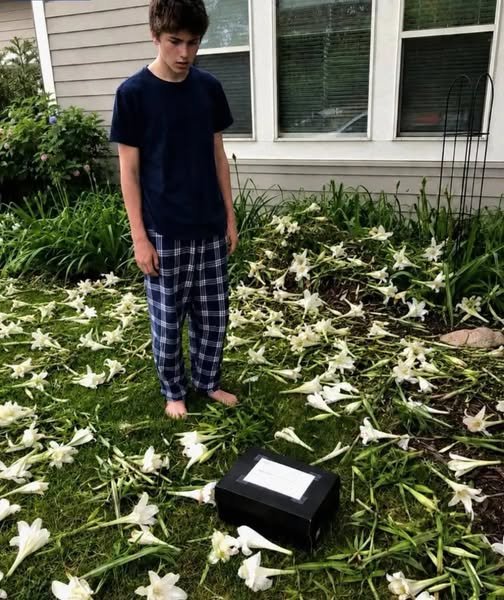
The devastated flowerbed on the morning of Logan’s fifteenth birthday.
I looked down, and my breath caught in my throat. Every single white blossom had been cleanly severed from its stalk. The green stems still stood upright like amputated fingers, but the delicate white flowers lay butchered, scattered carelessly across the wet lawn. Petals were crushed, pollen smeared into the dark mulch.
Logan stepped into the garden as if trapped in a nightmare, his hands hovering over the ruined bed. “No… no, no, no.”
He dropped to his knees, scooping up one limp, decapitated bloom, then another. Tears spilled over his eyelashes and ran down his cheeks. “Who would do this? Why would someone destroy my sister’s flowers?”
I rushed down the steps to wrap my arms around him, but as I reached the edge of the border, my eyes locked onto something alien sitting among the hacked stems.
A matte-black wooden box. It had been positioned with deliberate precision in the dead center of the garden.
“Logan, wait—don’t touch that,” I warned, my parental alarm bells screaming.
He didn’t listen. He reached out with trembling hands. “Mom, look. It has my name on it.”
Taped securely to the lid was a plain white envelope. Written across it in dark, bold marker were two simple words: FOR LOGAN.
My fingers shook as I ripped the envelope from the wood. Inside was a single folded sheet of stationery. The handwriting was jagged, uneven, and pressured, as if the person holding the pen had been battling their own hands while writing it.
I read the first sentence aloud, my voice dropping to a whisper:
“Your mother told you what she was told. But neither of you knows what really happened to Lily.”
A wave of cold nausea washed over me. Logan pressed close against my shoulder, his tear-streaked face searching mine. “What does that mean, Mom? What is this?”
“I don’t know,” I breathed, staring at the second line of the letter:
“Open the box, Logan. It’s time you learned the truth.”
Before I could stop him, Logan flipped open the brass latches and lifted the heavy black lid.
The long-hidden contents of the black box, preserved in secret for fifteen years.
Sitting on top was a tiny, faded knit infant cap, white with a pale pink thread woven through the brim. Beneath it lay two clear plastic hospital identification bracelets, slightly yellowed with age, and a vintage photograph resting face-down at the bottom.
Logan picked up the first bracelet, his thumb tracing the embossed plastic letters. “LOGAN. June 14.” He reached back into the box and lifted the second band. His breath hitched violently. “LILY. June 14… twelve minutes later.”
He turned his wide, terrified eyes up to mine. “Mom… these are from the hospital. These were hers.”
I couldn’t speak. I had begged the hospital for mementos fifteen years ago, and I had been told gently that in the chaos of my medical emergency and Lily’s passing, everything had been misplaced or discarded.
Then Logan reached for the photograph at the bottom of the box. He flipped it over—and let out a sharp, guttural scream.
“MOM! LOOK AT THIS!”
I snatched the photograph from his fingers, my vision blurring before snapping into agonizing focus.
In the picture, two newborn infants lay side-by-side beneath a single thermal hospital blanket. One baby was robust and pink-cheeked, sleeping peacefully. The other was significantly smaller, nestled inside a nest of clear monitoring tubes, her chest rising against medical tape. But their tiny arms had been arranged so that they touched—and the smaller baby’s microscopic fingers were curled firmly, tightly, around the chubby fingers of her brother.
Logan pointed at the picture, his fingertip striking the glossy surface so hard it made a snapping sound. “That’s me. That’s really me with her.”
I read the printed label attached to the crib in the corner of the photo: Baby Boy Logan. Baby Girl Lily.
My knees gave out completely. I collapsed right there into the wet, petal-strewn grass. “No… this is impossible.”
“You told me I never met her, Mom!” Logan cried out, his voice cracking into full-blown hysterics. “You always told me she was gone before I ever got to see her!”
“I told you what I was told!” I sobbed, clutching the photo to my chest. “I swear to God, Logan, I didn’t know this existed!”
“Then who took this?!”
“I did,” a deep, hollow voice answered from behind us.
The Fifteen-Year Lie
We both snapped our heads toward the side of the house. Alex was standing near the garage. He wasn’t wearing his pajamas; he was fully dressed in work boots, jeans, and a jacket. His eyes were bloodshot, his jaw set in a grim, tortured line. He looked like a man who hadn’t slept in weeks.
I looked at the photograph in my trembling hand. I looked at the severed lily stems. Then I looked back at my husband.
“You,” I whispered, the word tasting like poison. “You did this.”
Alex slowly closed his eyes and nodded. “Yes.”
Logan rose to his feet, holding the second hospital bracelet like an indictment. “Dad? You cut Lily’s flowers?”
“I didn’t destroy the bulbs, Logan,” Alex said, his voice flat with exhaustion as he walked toward the flowerbed. “The roots are still fine.”
“That’s supposed to make this okay?!” I screamed, standing up and closing the distance between us. “You vandalized your own son’s garden on his fifteenth birthday! You left this cryptic, terrifying note! Why would you do something so monstrous?!”
“Because you were never going to stop!” Alex yelled back, his composure finally cracking. He pointed an accusatory finger at the scattered white petals. “Every single year, on the day he is supposed to celebrate being alive, he picks one flower for Lily and spends the rest of the day grieving a ghost! He carries a debt he never owed!”
He took a shuddering breath, his chest heaving. “I knew that if I asked you to stop, you’d call me cold. If I told you to move on, you’d say I didn’t care. I had to break the ritual completely. I had to force you to open that damn box.”
“You don’t smash what someone loves and call it healing!” I countered, tears streaming down my cheeks. “How long have you had that box, Alex? How long have you kept that photograph from me?”
Alex looked down at the mud on his boots. “Fifteen years.”
The number hung in the air like a guillotine.
“Fifteen years?” Logan repeated, his voice small and devastated. “You had my sister’s bracelet… you had a picture of us holding hands… and you hid it in a closet for my entire life?”
“At first, I thought I was protecting your mother,” Alex pleaded, turning toward me with tears finally escaping his eyes. “Joana, you came home from that hospital barely holding onto sanity. You had almost died on that operating table. Every time anyone mentioned Lily’s name, you collapsed into grief for days. The doctors told me that additional stress could trigger another relapse. I told myself I’d show you the picture when you were stronger.”
“And then?” I demanded, my hands clenched into fists. “What about when five years passed? Ten years? What was your excuse then?”
Alex swallowed hard, looking broken. “After a while… telling the truth meant confessing how long I had already lied. Every year I stayed silent made it impossible to speak up the next year. I was terrified you’d never forgive me.”
“So you kept deciding for us,” I spat. “You made yourself the gatekeeper of my grief and my son’s identity.”
Logan stepped closer to his father, the tiny knit beanie clutched tightly in his fist. “Dad… how long did she live?”
Alex flinched as if struck. He rubbed both palms across his weary face, groaning softly. “Longer than you were told.”
“How long?” I demanded, stepping forward until I was inches from his chest. “Tell me right now, Alex!”
“Four hours,” Alex whispered, his voice cracking completely. “She lived for four hours.”
The ground seemed to tilt beneath me. Four hours. My daughter had breathed the air of this earth for four whole hours while I lay unconscious in a drug-induced haze, and her own father had told me she died the moment she arrived.
“You stole that from me,” I choked out, a sob tearing through my lungs. “You let me believe she never even took a breath.”
“You were dying, Joana!” Alex cried out desperately. “The alarms were going off, nurses were running everywhere, you were hemorrhaging! I was alone in that hallway holding two fragile babies, terrified I was about to lose all three of you at once!”
He stopped, gasping for air, before turning his gaze back to Logan. “I know I ruined this morning. I know I broke your trust. But you need to hear the whole story—and you shouldn’t hear it just from me. There’s someone waiting to see us.”
Logan wiped his nose with the back of his hand. “Who?”
“The neonatal intensive care nurse who was on duty that night,” Alex said softly. “The one who placed you two together. I spent the last three months tracking her down. She agreed to meet us this morning.”
Logan looked down at the black box, then back at his father. His jaw tightened with a resolve far beyond his fifteen years. He carefully gathered the bracelets, the tiny pink-striped cap, and the photograph, placing them securely inside the box. He tucked the container under his arm.
“Let’s go,” Logan said coldly. “And don’t expect me to say thank you.”
The Testimony of Hands
The twenty-minute drive across town was suffocating. Alex drove in silence, his knuckles white against the steering wheel. I sat in the passenger seat staring resolutely out the side window, refusing to acknowledge him. In the back seat, Logan held the black box tightly across his lap, his head leaned back against the headrest, staring up at the roof of the car.
Halfway through the trip, his quiet voice broke the silence.
“Dad?”
Alex’s eyes instantly darted to the rearview mirror. “Yeah, buddy?”
“Did she know I was there?”
Alex’s throat bobbed. He didn’t offer an easy answer this time. “That’s why we’re going to see Nurse Evelyn,” he said softly.
We arrived at a modest, sunlit bungalow on the outskirts of the neighboring town. An elderly woman with silver hair pulled back in a neat clip and kind, crinkled blue eyes opened the door before we even knocked. She looked at Alex, then at me, and finally settled her gaze on Logan. A warm, mournful smile crossed her face.
“You look just like your father did when he paced my nursery hallway fifteen years ago,” she said gently, stepping aside to welcome us in.
Nurse Evelyn recounting the night the twins spent together in the NICU.
We sat around her wooden kitchen table. A fresh pot of chamomile tea sat untouched in the center. Logan reverently set the photograph on the polished wood, sliding it toward her.
Nurse Evelyn slipped on a pair of reading glasses and looked down at the image. Her expression softened with profound recognition.
“I remember this night like it happened yesterday,” she said, her voice rich with decades of compassion. “You don’t forget nights like that.”
She looked up at me. “Your husband was terrified, Joana. You were in intensive recovery after a severe hemorrhage, and Lily was failing rapidly. Her little lungs simply weren’t ready for this world. The pediatric team tried everything, but after two hours, we knew her heart was giving out.”
I buried my face in my hands, the phantom phantom grief of that distant night crashing over me like a tidal wave.
“Alex was running back and forth between your room and the NICU,” Evelyn continued, reaching across the table to lay a gentle hand on mine. “He wouldn’t leave either of you. But when the doctor told him Lily wouldn’t survive the morning, he asked me something that parents rarely think to ask in the middle of shock.”
She turned her attention back to Logan. “Your father asked me three separate times if it was safe to bring you out of your warming crib and lay you next to your sister. He was terrified of compromising your health, but he refused to let her leave this world without knowing her family.”
Logan leaned forward, his voice barely a whisper. “Did you let him?”
“I did,” Evelyn said with a firm nod. “I swaddled you both and tucked you under the same blanket. Lily had been crying—restless, agitated, struggling against the monitors. But the second we placed your skin against hers, something remarkable happened.”
She pointed a finger at the photograph on the table.
“She stopped crying. Her heart rate, which had been dangerously high, stabilized for nearly an hour. And then she reached her arm out and gripped your fingers. You held onto each other like that until her very last breath.”
Tears poured freely down Logan’s face, splashing onto the edge of the wooden table. “Did she know I was there?”
Nurse Evelyn took her time before replying. She looked directly into Logan’s eyes with absolute conviction.
“Science tells us about reflexes and neural pathways, Logan. But after forty years in neonatal care, I can tell you something medicine can’t explain: twins have a language that begins long before they take their first breath. I cannot tell you what Lily understood with her mind. But I know with every fiber of my being that she felt your warmth, she heard your heartbeat, and she did not die alone.”
She paused, looking between Logan and Alex. “And more importantly, young man… you weren’t alone, either.”
Logan folded his arms over the table and buried his head, weeping with a depth of emotion that seemed to purge a decade of unresolved grief. Alex stood up and took a hesitant step toward him, then stopped himself. For the first time in fifteen years, Alex didn’t force a hug or dictate the narrative. He simply stood nearby, his head bowed, offering his silent, humble presence.
After several minutes, Logan sat up and wiped his cheeks. He picked up the photograph and looked at his father. “Why did you keep this from me?”
Alex swallowed hard, his voice trembling. “Because I looked at you growing up strong and healthy, and every time I looked at that picture, I was terrified you’d look at it and suffer from survivor’s guilt. I was afraid you’d spend your whole life wondering why you got to live and she didn’t.”
Logan stared at his father, shaking his head slowly. “Dad… I was already doing that. Every single June, I was already doing that.”
The Second Lily
The ride home was quiet, but the air inside the car felt different. The suffocating weight had dissolved into a tender, fragile calm. When Alex pulled into the driveway, the severed white flowers still lay scattered across the lawn under the bright midday sun.
Alex turned off the ignition, stepped out, and immediately bent down to begin clearing the debris. But midway through scooping up an armful of crushed stems, he froze.
He turned toward the car and looked at Logan. “What do you want to do with these?”
It was a simple question, but it carried monumental weight. For fifteen years, Alex had acted as the self-appointed architect of our family’s emotional life, deciding what we could handle and when. Now, he was stepping back, yielding control to his son.
Logan walked over to the ruined flowerbed and knelt down. With quiet care, he sorted through the fallen blooms, inspecting the stems until he found two flowers whose petals had escaped undamaged. He stood up, holding the two white lilies in his hands.
“I still want to go to the cemetery,” Logan stated plainly.
“Of course,” I said, stepping up beside him.
Alex looked at the two stems in Logan’s hand. “Both of them?”
Logan met his father’s gaze. “You’ll see.”
An hour later, the three of us stood beneath the weeping willow at the cemetery. For ten consecutive birthdays, I had stood in that exact spot watching my son perform the same rigid ritual: kneeling solemnly, placing the finest flower beside his sister’s engraved name, and whispering apologies disguised as prayers.
This time, Logan sat cross-legged directly on the grass. He laid a single white lily across the cold granite marker.
Then, he pulled the hospital photograph from his pocket and set it down beside the flower. For a long time, he just stared at the two tiny babies holding hands under that thermal blanket. A gentle summer breeze rustled the leaves overhead, dappling the stone in golden sunlight.
Finally, a small, uneven chuckle escaped his lips.
“All this time,” Logan whispered to the headstone, his voice laced with wonder, “I thought I had to keep bringing you things. I thought I had to keep paying you back because I got all the birthdays and you didn’t.”
Alex turned his head away, his shoulders shaking with silent sobs.
Logan gently touched the corner of the photograph where his baby sister’s tiny fingers were locked around his own. “Guess you gave me the best gift first.”
I wept then—not out of sorrow, but out of immense, liberating relief. My fifteen-year-old son had spent ten years carrying the crushing weight of an invisible debt, trying to compensate for living while his twin had died. And in a single morning, that debt had been erased by the revelation of four short hours of love.
When we arrived back home, the front lawn looked bare without the flowers, but the bed was raked smooth. Logan carried the second white lily into the house, holding it carefully by the stem.
Alex followed him into the kitchen, his posture hesitant. “Logan… I’m so sorry about this morning. I shouldn’t have cut them. I should have just sat down and talked to you like a man.”
Logan looked at the kitchen table, where his unopened birthday cake was waiting. He walked to the cupboard, pulled down an ordinary drinking glass, filled it with cool tap water, and placed the second lily inside.
“You should have, Dad,” Logan said honestly, looking his father in the eye. “You really should have.”
“I know that now,” Alex whispered.
Logan studied him for a long moment, then nodded slightly—not fully erasing the hurt, but opening the door to forgiveness.
I stepped over to the counter and pointed to the flower in the glass. “Is that one for Lily too?”
Logan adjusted the stem so the white petals faced the room. Then he shook his head and offered a genuine smile.
“No,” he said softly. “That one’s for us.”
A new tradition born from truth: celebrating the living alongside the remembered.
Alex pulled out a chair and sat down beside our son. I took a box of matches from the drawer and lit the fifteen candles one by one, their small golden flames dancing in the quiet kitchen.
Outside by the porch, Lily’s Garden had no blossoms left to show. But the bulbs were still safe beneath the warm, fertile earth, sleeping quietly, ready to push through the soil and bloom again when the season was right.
For the first time since he was five years old, nobody reminded Logan that we had to visit the cemetery before we could celebrate. Nobody told him what his survival was supposed to feel like. Nobody treated his birthday as an apology for an absence.
The white lily stood tall in its glass of water beside the black keepsake box, reflecting the warm glow of fifteen tiny fires.
“Make a wish, birthday boy,” I said, resting my hand on his shoulder.
Logan closed his eyes, took a deep, full breath of air, and blew out every single candle.
And for the first time in fifteen years, the flower stayed inside with us.
Note:This work is inspired by real events and people, but it has been fictionalized for creative purposes. Names, characters, and details have been changed to protect privacy and enhance the narrative. Any resemblance to actual persons, living or dead, or actual events is purely coincidental and not intended by the author.
All images used in this article are AI-generated and intended for illustrative purposes only.