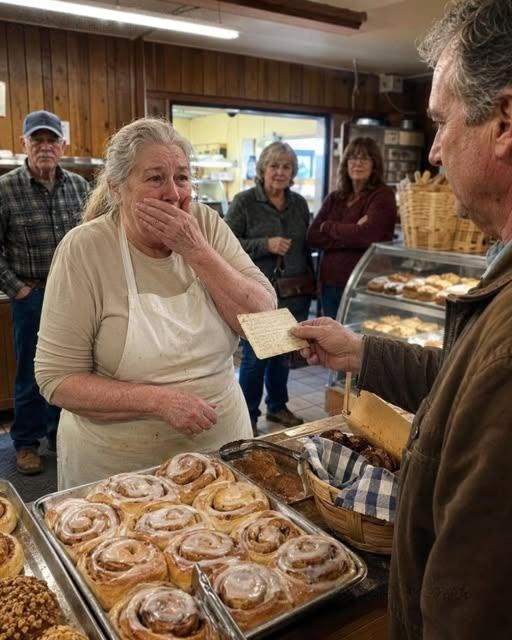
Everyone Called the Landlord Heartless for Raising an Elderly Baker’s Rent—Until He Returned With the Recipe Card She Thought Was Lost Forever
“You have thirty days, Mrs. Reyes.”
I was standing behind the bakery counter when my landlord said it. My hands were swollen from rheumatoid arthritis, and the morning’s first batch of cinnamon rolls was cooling beside me.
For forty-one years, I had opened that little bakery before sunrise.
I had kneaded dough through snowstorms, power outages, my husband’s funeral, and every kind of heartache a person could carry.
But that morning, I couldn’t make my fingers close around the envelope Calvin Price had placed on the counter.
“The new rent is in there,” he said quietly.
I looked at the number and felt the room tilt.
It was almost double.
“I can’t pay this,” I whispered.
Calvin stared at the floor.
He was fifty-three, tall and serious, with silver beginning to show at his temples. He had inherited the building after his father died, and although he had lived in our small Ohio town as a boy, he had spent most of his adult life somewhere else.
“I’m sorry,” he said.
Then he walked out.
By lunchtime, everyone knew.
That is how small towns work.
The barber came in shaking his head. The woman from the flower shop called Calvin heartless. Someone taped a handwritten sign to my front window that said, “SAVE MARLENE’S BAKERY.”
A photograph of the notice spread around town.
People who had never met Calvin decided exactly what kind of man he was.
Greedy.
Cold.
The kind who would throw an elderly widow into the street for a few extra dollars.
I didn’t defend him.
At the time, I thought they were right.
My bakery wasn’t fancy.
The floorboards creaked. The bell above the door had been repaired with wire. The display case fogged up whenever it rained.
But it had been my whole life.
My husband, Tomas, and I opened it in 1985 with one borrowed oven and twenty-three dollars left in our checking account.
He made the coffee.
I made the bread.
In those early years, factory workers stopped in before their shifts. Mothers brought children after school. Farmers came in with mud on their boots and paid me on Fridays when their checks cleared.
Nobody ordered anything with a complicated name.
They wanted black coffee, warm rolls, apple pie, and a place where someone remembered them.
After Tomas died, the bakery became the reason I kept getting out of bed.
Then arthritis settled into my hands.
Some mornings, twisting the key in the front door hurt so badly that I had to stop and breathe.
I started mixing dough with a machine instead of by hand. I dropped trays. I burned things I had made a thousand times.
Still, I opened.
People depended on the bakery, and I suppose I depended on them too.
But the rent notice changed something in me.
For the first time, I looked around and realized I might not be strong enough to keep fighting.
I decided to close at the end of the month.
The town refused to accept it.
People held a bake sale for the baker.
Children emptied piggy banks onto my counter. Retired men offered to repair the roof. A teenager I barely knew handed me eighty-seven dollars he had saved for a new phone.
I cried more during those thirty days than I had in years.
But kindness could not change the numbers.
Even with the donations, I couldn’t afford the rent for long.
On my final Saturday, I woke at two in the morning.
My hands were stiff, but I wanted to bake everything one last time.
I made Tomas’s sourdough.
I made the cherry turnovers my daughter loved as a child.
And I made cinnamon rolls using the recipe my mother had written on an index card decades ago.
The original card had disappeared years earlier.
I assumed it had been thrown away during one of the bakery renovations, but I knew every ingredient by heart.
By six, a line had formed around the block.
People came carrying flowers, photographs, and stories.
One woman showed me a picture of her parents cutting their wedding cake inside my bakery in 1992.
A former teacher reminded me that I had once delivered soup to her house every day while she recovered from surgery.
A grown man introduced me to his two daughters and said, “When I was a kid, you let me sit here after school because my house wasn’t always a good place to go.”
I remembered his face.
I had forgotten the rest.
That is the strange thing about small kindnesses.
The person giving them may barely remember.
The person receiving them may carry them forever.
Around noon, the bell above the door rang.
The entire bakery went quiet.
Calvin Price walked in.
Someone near the back muttered, “You’ve got some nerve.”
Calvin heard it, but he didn’t respond.
He carried an old metal recipe box under one arm and a thick folder in his hand.
He approached the counter slowly.
“I found this while cleaning out my father’s house,” he said.
He placed the recipe box in front of me.
My breath caught.
It was faded yellow with tiny painted strawberries around the lid.
I had not seen it in more than thirty years.
“Tomas gave it to my mother,” Calvin said.
I opened the box with trembling fingers.
Inside were dozens of recipe cards in my mother’s handwriting.
Bread.
Pie crust.
Peach preserves.
And there, stained with cinnamon and butter, was the original recipe for my rolls.
I pressed the card against my chest.
“How did your mother have this?”
Calvin looked around the crowded bakery.
His voice became softer.
“When I was nine, my father lost his job.”
No one moved.
“We didn’t have much food for a while,” he continued. “My mother was too proud to ask anyone for help. She would send me outside around dinnertime so I wouldn’t see her skip meals.”
He pointed toward the table beside the front window.
“I used to sit there.”
Then I remembered him.
A thin boy with a coat too small for him.
He came in near closing time and always asked how much the day-old rolls cost.
I had known he didn’t have money.
So I told him they were free after six.
They weren’t.
I had simply made up the rule for him.
“You packed bread into paper bags for me,” Calvin said. “You always added two cinnamon rolls and told me they were damaged.”
A few people laughed through their tears.
“They were never damaged,” he said.
I covered my mouth.
Calvin’s mother had eventually found work in another town. Before they moved away, she asked Tomas for my recipes because she wanted to bake the same rolls for her son.
She had kept that little box for the rest of her life.
Calvin slid the folder across the counter.
“The rent notice came from my father’s estate,” he explained. “The building had already been promised to a development company. They planned to tear down this entire block.”
People began whispering.
“I bought it from them,” he continued. “The paperwork took longer than I expected, and I wasn’t legally allowed to announce the purchase until it closed.”
He opened the folder.
The sale had been completed the previous afternoon.
Then he handed me a new lease.
The rent was one dollar a year.
I stared at him.
“I don’t understand.”
Calvin smiled for the first time since entering.
“You fed my family when we were ashamed to admit we were hungry,” he said. “I’m not going to let anyone take this place from you.”
The bakery erupted.
Some people cheered. Others cried. The barber who had called Calvin heartless pushed through the crowd and apologized.
Calvin shook his hand.
“I understand,” he said. “From where you were standing, I probably looked heartless.”
Then he turned back to me.
“There is one condition.”
I wiped my eyes.
“What condition?”
He glanced at the cinnamon rolls cooling behind me.
“The free-after-six rule still applies.”
I laughed so hard my hands stopped hurting for a moment.
The bakery did not close that day.
The town helped repaint the walls, repair the old sign, and install equipment that was easier on my joints.
Calvin came every Saturday morning.
He always sat at the table near the window, the same place where a hungry nine-year-old boy had once waited for a paper bag of “damaged” rolls.
Sometimes people asked why I had helped him all those years ago.
I never had a grand answer.
It seemed like such a small thing at the time.
A little bread.
A warm roll.
A way to let a struggling family accept help without losing their dignity.
I never imagined that kindness would return four decades later carrying my mother’s recipe box and the keys to my future.
We are often too quick to decide who the villain is.
We see one letter, one moment, or one mistake, and believe we know the whole person.
But every human being is carrying chapters we have not read.
And every kindness we give may be remembered far longer than we ever know.
The bread you give away today may become the shelter that saves you tomorrow.