The Echo of an Empty Barn
Caleb Rourke stood in the center of the sprawling, empty milking stall, his calloused hand resting gently on a rusted iron gate that no longer needed to be closed. The silence in the barn was deafening.
For the first time in forty-three long, arduous years, there wasn’t a single cow left in his barn. The familiar scent of sweet hay and warm animals lingered, but the life of the place was gone. Through the biting chill of the Wisconsin winter air, he could still hear the faint, metallic rattling of the livestock trailer disappearing down the frozen county road.
Even though he was sixty-seven years old—a man hardened by decades of unforgiving weather and early mornings—Caleb lowered his silver head against the rough-hewn wooden post, closed his eyes, and finally wept.
The silence of a barn that had known life for forty-three years was the heaviest weight Caleb had ever carried.
The Weight of Memories and Daisy the Cow
The cow he had just sold wasn’t worth much by modern dairy-farm standards. But Daisy was never just a cow to Caleb. She was a living, breathing memory. Daisy had been the very last animal his late wife, Ellen, had raised with her own hands.
He remembered it vividly: a brutal February storm had nearly frozen the newborn calf. Ellen had brought the shivering creature right into their farmhouse kitchen, bottle-feeding her until she was strong enough to stand. For twelve beautiful years, Ellen used to joke that Daisy was convinced she was part golden retriever.
“She’d come inside and sit on the rug if you’d let her,” Ellen would laugh, her eyes bright with joy.
Ellen had a way of bringing warmth to everything she touched, even in the middle of a brutal Wisconsin winter.
Caleb would always pretend to complain about the cow’s spoiled nature. But every evening, without fail, he loved watching his wife lean over the fence, scratching Daisy between the ears as if she were greeting a childhood friend.
Then, the unimaginable happened. Ellen got sick.
What started as a few routine appointments quickly spiraled into a grueling calendar filled with hospital visits, long silent drives, and towering stacks of prescriptions. Caleb’s days became an exhausting blur: he would milk the cows before sunrise, drive Ellen to her treatments, and return home long after dark just to start his chores all over again.
Through it all, Ellen apologized constantly. That broke Caleb’s heart more than the physical exhaustion ever could.
“You didn’t choose this,” he’d whisper, holding her fragile hand. But she worried relentlessly—about the farm, the mounting bills, and mostly, about him.
One quiet evening, sitting beneath a handmade quilt on the porch, Ellen looked out toward the barn. “Promise me,” she said softly, “you won’t work yourself into the ground just because I’m gone.”
Caleb frowned, refusing to accept the reality. “You’re not going anywhere.”
She gave him that knowing, peaceful smile—the kind people give when they understand a truth you aren’t ready to face. Three months later, Caleb buried his wife of forty-one years.
A Bitter Winter and a Breaking Point
After the funeral, the town did what good towns do. Neighbors brought casseroles, friends chopped and stacked his firewood, and cards flooded the mailbox. But eventually, the casseroles ran out, the visitors faded, and life moved forward.
Caleb stayed on the farm, convincing himself that keeping the land alive meant keeping a piece of Ellen alive, too. He kept her favorite coffee mug on the table, eating alone under the ticking clock she’d bought at a yard sale thirty years prior.
Then came the winter that nearly finished him. It was a season of relentless hardship:
- The temperature plummeted below zero and stayed there for days.
- A critical water line froze and burst.
- The main tractor broke down, requiring parts he couldn’t afford.
- Global feed prices skyrocketed, and two of his remaining cows fell ill.
Finally, the envelope arrived. Caleb was months behind on his mortgage. Paired with the towering stacks of Ellen’s medical bills, the math was impossible. He spent nights staring at a calculator, but the numbers never changed. He sold his equipment first. Then, piece by piece, he sold the herd.
Finally, there was only Daisy.
When the livestock buyer arrived, he took one look at the old cow, then at Caleb’s heartbroken expression. “You sure about this?”
Caleb looked at the farmhouse window, half-expecting to see Ellen standing there in her blue sweater. The vision faded. “No,” he admitted. “But take her.”
Caleb refused to look at the check. He walked Daisy to the trailer himself, rubbing the familiar white patch on her forehead one last time. As Daisy nudged his coat pocket looking for the treats Ellen used to carry, Caleb had to turn away. He didn’t eat dinner that night. He just sat in Ellen’s empty chair and whispered into the dark kitchen, “I tried.”
The Morning the Driveway Filled
The next morning, Caleb was jolted awake by the heavy rumble of engines. Lots of them. Assuming there had been a pile-up on the icy road, he threw on his boots and rushed to the porch.
He froze in his tracks.
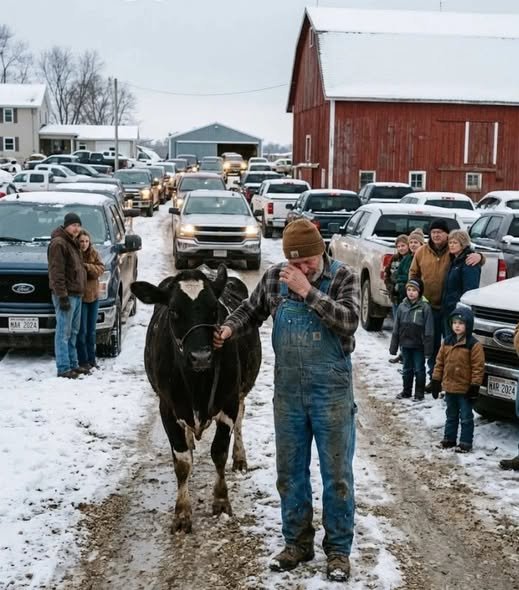
His long dirt driveway was completely packed with pickup trucks. There were red ones, white ones, pristine new models, and rust-bucket farm trucks. They were parked on the grass, along the road, and right up to his steps. There had to be forty of them.
At first, Caleb thought there had been an accident. He never expected a miracle.
Dozens of people—men in work boots, women in winter coats, teenagers, and little kids—climbed out. His neighbor, Wade Mercer, led the pack, carrying a steaming thermos of coffee. Behind Wade was a woman Caleb faintly recognized from the grocery store, followed by a man who used to buy milk from the farm two decades ago.
“What happened?” Caleb stammered.
Wade took off his cap. “Nothing happened.”
“Then why are you all here?”
Wade gestured toward the road as another truck pulled in. “You sold Daisy yesterday, Caleb.”
Caleb’s jaw tightened defensively. “That isn’t anybody’s business.”
“Maybe not,” Wade replied gently, handing him the thermos. “But Ellen made people her business for forty years.”
The Return of Daisy
Before Caleb could process the words, a familiar vehicle backed slowly up the drive. It was the livestock trailer.
The heavy metal gate swung open, and out stepped Daisy. The old cow blinked in the morning sun, scanned the crowd, and immediately trotted straight toward Caleb. A little boy clapped his mittens together, and soft laughter rippled through the crowd.
For the first time since Ellen passed away, Caleb realized he wasn’t carrying the weight of the world alone.
Caleb covered his mouth, tears springing to his eyes. “What did you people do?”
A woman named Teresa stepped out of the crowd. “I don’t know if you remember me, Mr. Rourke. Thirty-two years ago, I came here on a fourth-grade field trip. You let me bottle-feed a calf. I went home and told my dad I wanted to be a farmer. I didn’t become one… but I never forgot the kindness of this place.”
Then, the floodgates opened.
One man stepped up and shared how Ellen had quietly paid for his family’s groceries when his father was laid off. A retired teacher talked about how Caleb had welded the school’s broken utility trailer for free. A mother tearfully recalled how Ellen let her kids play with the newborn calves to escape the trauma of a bitter divorce.
Caleb remembered these moments only as tiny fragments. To him, they were just things neighbors did. Things you didn’t keep score of.
Wade stepped forward and pressed a thick envelope into Caleb’s shaking hands. Inside was a cashier’s check. Caleb stared at the number, his knees buckling. It was more than enough to cover the overdue mortgage, the medical bills, and then some.
“No,” Caleb choked out, his voice cracking. “I can’t take this. I spent my whole life handling my own problems.”
An elderly farmer near the back called out, “So did the rest of us! Didn’t stop you and Ellen from helping when we needed it.”
The True Meaning of Strength
For his entire life, Caleb had believed that strength meant carrying heavy burdens without a single complaint. Bad harvests, sickness, crushing debt, and profound grief—you woke up, you worked, and you endured alone.
But standing there on his porch, surrounded by forty pickup trucks and a lifetime of goodwill returning to him, Caleb finally understood the lesson Ellen had always known: There is a profound difference between being strong and being alone.
He sat down right there on the frozen barn steps, and when Daisy pushed her wet nose into his shoulder, Caleb broke down and cried openly. Nobody looked away. Wade sat right down beside him. Someone poured more coffee. And for the first time since he lost Ellen, the farm didn’t feel empty anymore.
Later that afternoon, Caleb found a handwritten note tucked deep inside the envelope, written in a child’s messy scrawl:
“Mr. Rourke, you probably don’t remember all the people you helped. But they remember you.”
Caleb taped that note above his kitchen sink, right next to the picture of Ellen.
The farm never became wealthy, and Caleb never wanted it to. He kept just enough cows to stay busy, rented the rest of the pasture to a young family, and finally learned to pick up the phone and ask for help when the tractor broke down.
And every single February, Caleb opens his barn doors, inviting the entire town over for hot chocolate, coffee, and fresh pancakes. He calls it Ellen’s Day.
When people ask him why he hosts it, he simply looks over at Daisy’s stall and smiles.
“We think the good we do disappears after the moment passes,” Caleb always tells them. “It doesn’t. Sometimes it just waits quietly in other people’s hearts until the day we need it returned.”
Note:This work is inspired by real events and people, but it has been fictionalized for creative purposes. Names, characters, and details have been changed to protect privacy and enhance the narrative. Any resemblance to actual persons, living or dead, or actual events is purely coincidental and not intended by the author.
All images used in this article are AI-generated and intended for illustrative purposes only.