The Burden of Goodbye: Why I Refused to Let My Son Fix His Father’s Heartbreak
Two days before the chaotic, exciting rush of seventh grade was set to begin, my twelve-year-old son, Noah, called me and delivered a sentence that brought my entire world to a screeching halt: he wasn’t coming home.
That sentence alone would have terrified any mother. But then Noah added something else—something that made my stomach drop and the breath leave my lungs entirely.
“Jessica’s better than you, Mom,” he said, his voice unusually strained. “We can finally be a real family here.”
And somewhere in the background, just barely audible through the phone’s receiver, I heard his stepmother whispering.
Our home wasn’t glamorous, but it was filled with little traditions that made it ours.
My ex-husband, Matt, and I had been divorced for six long years, and Noah had spent the vast majority of that time living with me. Our home wasn’t exactly glamorous or perfectly curated like a magazine cover, but it was unmistakably ours. It was a space filled with warmth, laughter, and deeply rooted routines.
Friday nights meant homemade pizza, no matter how exhausted we were. Sunday mornings meant messy pancakes with far too much syrup. And every single school day, I slipped ridiculous, brightly colored yellow sticky notes into his lunch bag. Noah, being a growing pre-teen, always claimed they embarrassed him to no end, yet somehow, I noticed he never actually threw them away.
That summer, we had spent weeks excitedly getting ready for his transition to middle school. His brand-new sneakers were sitting perfectly by the front door, waiting for their debut. His crisp, unmarked notebooks were stacked neatly on his bedroom desk. I had even gone to three different grocery stores to find the specific cinnamon cereal he had reminded me about twice.
Noah had spent the final two weeks of his summer vacation at his father’s house with Matt and his new wife, Jessica. To my knowledge, there had been nothing unusual about this visit. He called me almost every evening to recount his days. Just three days before school started, he had even called to ask whether I had washed his favorite blue hoodie so it would be ready for Monday morning.
So, when my phone rang that bright Saturday afternoon, I answered cheerfully, completely unprepared for what was coming.
“Hey, kiddo,” I said, smiling at the caller ID. “You packed yet?”
Silence. A heavy, uncomfortable silence filled the line.
Then, his voice came quietly through the phone. “Mom…”
Something about his muted tone made my maternal instincts flare. I sat straighter in my chair. “What happened? Are you okay?”
“I’m not coming home.”
For several agonizing seconds, I simply stared blankly at the bright box of cinnamon cereal sitting on the kitchen counter. My mind scrambled to make sense of the words.
“What do you mean?” I asked gently.
“I want to stay with Dad.”
I genuinely thought I had misunderstood him. We had just finalized his back-to-school checklist. “Noah, school starts on Monday.”
“I know.”
“You were just asking me about your blue hoodie three days ago.”
“I changed my mind.”
The sudden realization that something was deeply wrong left me frozen in my kitchen.
I closed my eyes and forced myself to remain calm, suppressing the rising panic in my chest. “All right. Then tell me what changed.”
There was another long, painful pause. Then, Noah said the words I never expected to hear from my sweet boy.
“Jessica’s better, Mom.”
My fingers tightened around the phone until my knuckles turned white. “Better at what?”
“Everything.”
“Noah…”
“We can be a real family here.”
That single sentence hurt far more than I ever wanted to admit. For six years, I had poured my heart and soul into making sure my son never felt like a product of a broken home. I wanted him to know our home was whole, complete, and brimming with love, even if his parents were no longer married.
“Honey, did someone tell you to say that?” I asked, keeping my voice as steady as possible.
“No.” He answered much too quickly, a classic tell that he wasn’t being truthful.
Then, I heard Jessica’s muffled voice in the background. “Give me the phone, sweetheart.”
“Noah, wait—”
The phone rustled loudly against someone’s clothing. Then, Jessica’s crisp voice came on the line.
“Rachel.”
“Put Noah back on the phone,” I demanded, dropping any pretense of friendliness.
“Please don’t make this more difficult than it needs to be.”
I froze. The sheer audacity of her statement stunned me. “Make what difficult?”
“He wants to stay here.”
“Since when?”
“Since he realized he has another option. We’ve already started checking out the middle schools in our district.”
I stood up so abruptly that my wooden kitchen chair scraped violently across the floorboards. “You’ve been looking at schools without even speaking to me?”
“Matt agrees with me.”
“Then put Matt on the phone. Let me talk to him.”
“He’s busy right now.”
“Jessica, this is absurd.”
“Noah needs stability, Rachel.”
I looked frantically across the kitchen at my son’s perfectly packed backpack sitting on the bench. “He already has stability. He’s had it for six years.”
Jessica let out a long, patronizing sigh. “Not the kind I mean.”
Then, without another word, she hung up.
The Drive and the Discovery
I didn’t hesitate. I immediately dialed Matt’s number. He answered after several excruciatingly long rings.
“Rachel,” he answered, sounding exhausted.
“What on earth is going on over there?”
“Can you lower your voice?”
“Absolutely not. Your wife just told me you’re planning to move Noah to another school without even consulting me.”
“It’s what he wants, Rachel.”
“Since when, Matt? He liked living with me perfectly well seventy-two hours ago.”
“Things change.”
“Not this much, and certainly not this fast.”
Matt went silent. He knew I was right.
“Put Noah on the phone,” I ordered.
“Not right now.”
“Why?”
“Because you’re upset, and I don’t want you pressuring him into anything.”
My anger, which I had been trying so hard to keep a lid on, suddenly flared hot and bright. “I am his mother.”
“And I am his father.”
“Then as his father, explain to me what suddenly changed his mind.”
“We’ll talk about this later.”
The call abruptly ended. I stood completely still in my kitchen for perhaps ten seconds. Normally, I was the kind of person who meticulously planned every aspect of my life. School forms were completed and signed the very day they arrived. Vacations had detailed, color-coded schedules. I even kept a stash of spare pencils in my car’s glove compartment because Noah had a supernatural ability to lose half a dozen in a single week.
But that afternoon, all my careful planning evaporated. I had only one overwhelming, singular thought: Something is terribly wrong.
I grabbed my car keys.
Halfway to Matt’s house, sitting at a red light, I tried calling Noah directly. It went straight to voicemail. Frustrated, I quickly typed out a text message.
I’m close. Can you come outside?
His reply pinged back almost immediately, and it chilled me to the bone.
Please don’t make Dad mad, Mom.
I read those seven words three times. Why would Matt be mad? Why was my twelve-year-old son suddenly walking on eggshells trying to manage his father’s temper? I pulled over a short distance from Matt’s house, put the car in park, and called Matt again.
“Bring Noah outside right now,” I said the second he answered.
“Rachel, you can’t just show up here uninvited.”
“He just texted me begging me not to make you angry.”
A heavy silence fell over the line.
“What exactly does he think you’re going to do, Matt?”
“Nothing,” Matt replied defensively. “He’s just being sensitive.”
“Since when does a twelve-year-old child have to manage your moods?”
“I’m hanging up.”
“Matt—”
But the line was already dead. I threw my phone onto the passenger seat, got out of my car, and began marching up the street.
By the time I reached their manicured front walkway, I was furious enough to pound their heavy wooden door right off its hinges. But as I approached the porch, I stopped. I could hear voices drifting through an open living room window.
It was Jessica. Her voice was sharp and accusing.
“You’ve complained for six entire years that you barely get to be his father.”
I froze in my tracks, holding my breath.
Matt answered, his tone equally sharp. “That doesn’t mean you get to tell my son that Rachel’s house isn’t a real home, or that she isn’t enough of a family for him.”
My breath caught in my throat.
Jessica scoffed. “I told him he deserves one home. One solid foundation.”
“No, Jessica. You told him what you needed him to believe so you could get your way.”
“I’m tired, Matt,” she fired back. “I’m incredibly tired of every good weekend we have ending with you being completely miserable because he leaves. I am exhausted from organizing my entire life around your relentless guilt.”
“So our twelve-year-old is supposed to solve that for you?”
“Maybe if he lives here permanently, you’ll finally stop acting like a piece of you is always missing or somewhere else.”
There was a long, heavy silence from inside the house.
Then, Matt asked a question that made everything suddenly, horrifyingly clear. “Does Noah know that’s the real reason why you want him here?”
Jessica’s voice lowered, defensive but unashamed. “I told him how much you need him.”
“You told my son I fall apart when he leaves?”
“Because you do, Matt!”
“You made him feel responsible for my emotional well-being.”
“I am trying to save our marriage!”
Outside on the porch, my hands began shaking uncontrollably. My instinct was to storm inside, unleash my fury on Jessica, and drag my son out of that toxic environment. I actually raised my fist, ready to bang on the door.
But then, I remembered the text message burning a hole in my phone. Please don’t make Dad mad.
If I stormed inside looking like a furious, unhinged ex-wife, Jessica wouldn’t have to do any more work to convince Noah that I was an angry mother trying to tear him away from his father. I would be proving her point for her. I would become the villain in her carefully constructed narrative.
So, slowly, deliberately, I lowered my hand. I turned around and walked quietly back down the path to my car.
For the first time that entire afternoon, I stopped reacting out of panic. I sat in my car, watched the front door, and I waited.
Unraveling the Lie
About fifteen minutes later, the front door opened, and Matt walked outside. He looked defeated. When he spotted me leaning against the hood of my car, he stopped in his tracks.
“You heard us,” he said quietly.
“I heard enough.”
He rubbed both hands over his face, a gesture of sheer exhaustion. “Rachel, please…”
“Does my son know that he’s apparently responsible for fixing your broken marriage?”
Matt flinched. “Don’t say it like that.”
“How exactly would you prefer I say it, Matt?”
“Nobody is using him.”
“He literally just told me on the phone that you and Jessica are his ‘real family’ and that I am not.”
Matt looked away, unable to meet my eyes. “Where did that even come from?”
“He likes being here, Rachel.”
“That wasn’t my question.”
“He likes having both of us around.”
“Matt,” I stepped closer, my voice low and fierce. “Why does our child believe that you will completely fall apart if he comes home with me?”
His jaw visibly tightened. “He’s just sensitive.”
“I want to speak to him. Now.”
Matt hesitated for a moment before nodding slowly toward the side yard. Noah was sitting completely alone on the concrete patio steps, looking smaller than he had in years.
Noah was carrying an emotional burden that no twelve-year-old should ever have to shoulder.
I walked over, my heart breaking with every step, and sat down quietly beside him on the cold concrete.
“Did Jessica tell you that your dad gets unhappy after you leave?” I asked gently.
His expression immediately hardened, defensive walls shooting up. “So now you’re just going to blame her?”
“I’m just asking you a question, sweetheart.”
“She cares about Dad.”
“I know she does.”
“And she cares about me, too.”
“I never said she didn’t, Noah.”
He finally turned to look at me, his eyes brimming with unshed tears. “Dad needs me, Mom.”
My response came much too quickly, driven by a fierce need to protect him. “Noah, you are twelve years old. Your father does not need you to fix his life.”
Instantly, I saw something shift and close off in his face.
“Maybe you don’t need me either, then,” he muttered.
“That isn’t what I meant at all—”
“Just leave me alone!”
He stood up abruptly and disappeared back into the house, letting the screen door slam behind him.
I sat on those steps staring at the closed door, overwhelmed with frustration. I had been one hundred percent right about what was happening behind the scenes. And somehow, through my own clumsiness, I had still managed to make everything worse.
So, I did the hardest thing imaginable: I went home without him.
But I wasn’t giving up. I realized that reacting with logic wasn’t going to work. I simply needed to ask a better question.
Breaking the Equation
Later that evening, the house felt unbearably empty. I wandered into Noah’s bedroom to feel closer to him. Inside one of his pristine new notebooks, I found an old, crumpled yellow note I had written for him months earlier.
Don’t forget your math packet, genius. Love you.
I smiled softly through a sudden wave of tears. Then, I sat on the edge of his bed and thought deeply about the exact phrases Noah had repeated to me on the phone.
Real family. Dad needs me. One home.
Those were absolutely not Noah’s words. Whenever my son felt overwhelmed or deeply stressed, he had a habit of borrowing language from the adults around him to articulate his feelings.
And suddenly, sitting in his quiet room, I realized my mistake. I had been asking him the wrong questions all along.
The following afternoon, I returned to Matt’s house. This time, my heart rate was steady. I hadn’t rehearsed a fiery argument in the car. I didn’t want a fight; I wanted the truth.
I found Noah sitting in the same spot outside.
“Can I sit with you?” I asked softly.
He offered a noncommittal shrug.
I sat beside him, leaving a little space between us. “I’m going to ask you just one question. And whatever your answer is, I promise you, I won’t argue. I just want to listen.”
He looked at me suspiciously from under his bangs. “Okay.”
“What do you believe will happen to your dad if you come home with me today?”
Noah stared down at the ground, picking nervously at the worn edge of his sneaker. “He’ll be alone again.”
“Jessica is there with him,” I reminded him gently.
“He gets really, really quiet when I leave.”
“Who told you that, buddy?”
He kept his eyes glued to his shoe. “Jessica.”
“What exactly did she say to you?”
“She said that Dad waits all week long just for me to come over. And then, when Sunday comes and I leave, he hardly talks to her for days.”
My heart completely sank. The manipulation was so clear.
“Did she say anything else?” I asked, keeping my voice perfectly level.
“She said… she said maybe if I just stayed here, Dad could finally be happy all the time.”
And there it was. The ugly truth.
Jessica had never directly ordered Noah to abandon me or stay with them. She was far too smart for that. Instead, she had planted a seed. She had created a devastatingly simple emotional equation in the developing mind of a deeply empathetic twelve-year-old boy.
Dad is desperately unhappy. Noah has the power to stay. Therefore, Noah staying equals Dad’s happiness.
“I have to help him, Mom,” Noah whispered, his voice cracking.
I turned my body fully toward him. “Noah, look at me. You are allowed to love your dad. You are allowed to miss him when you’re not here. And you are absolutely allowed to want more time with him.”
He looked up, surprised by my words.
“But listen to me carefully,” I continued, holding his gaze. “You are not responsible for keeping him happy. Your father is a grown adult. His emotions, his sadness, his happiness—those are his responsibility to manage, not yours.”
“Was Jessica lying to me?”
I almost said yes. It would have been so easy to villainize her. Instead, I chose my words with extreme care.
“I think Jessica told you things about your dad’s private feelings that a kid should never, ever have been asked to carry.”
“So… Dad isn’t sad when I leave?”
“He probably is sometimes. Goodbyes are hard.”
His face dropped in defeat.
“And so am I,” I added quickly. “I hate it when you leave to come here, too. I miss you terribly. The house feels too quiet, and I usually eat pizza by myself missing you.”
He stared at me, wide-eyed.
“But, Noah, that is my feeling to manage. Not yours. I would never ask you to fix my sadness.”
He was silent for a long, profound moment. The heavy weight of the weekend seemed to be pausing in mid-air.
“So… what am I supposed to do?” he finally asked, sounding like a lost little boy.
“Be twelve.”
He almost smiled.
“Let the adults handle the adult problems.”
Then, he gathered his courage and asked the question I had secretly been terrified of all weekend. “What if I actually do want to spend more time with Dad?”
The easiest, most selfish answer would have been an immediate no.
Instead, I took a deep breath. “Then we talk about giving you more time with him. We figure out a new schedule.”
His eyebrows lifted in shock. “You’re not mad?”
“I’m incredibly angry about how all of this was handled behind my back. But I am not angry—and I will never be angry—because you love your father.”
I stood up and offered him my hand. “Come with me.”
“Where are we going?”
“To talk to him. And this time, you don’t have to handle the hard conversation by yourself.”
Holding the Adults Accountable
Matt was standing nervously in the driveway when we came around the corner. The moment Jessica saw us through the window, she marched outside to join him, her posture rigid and defensive.
“We need to talk,” I said firmly.
Jessica crossed her arms tightly over her chest. “I think we’ve all already talked quite enough this weekend.”
“No,” I countered. “The adults have talked around Noah enough. Now we’re going to talk directly.”
I turned my attention entirely to Matt. “Noah believes that if he comes home with me today, you will become miserable and shut down.”
Matt looked down at our son, his face flushing with guilt. “Buddy…”
“Did you know he thought that?” I pressed.
Matt looked at me. His heavy hesitation was all the answer I needed. Noah noticed it too.
“Dad?” Noah asked, his voice trembling slightly.
Matt exhaled a long, shaky breath. “Sometimes… sometimes you ask me if I’m sad when you leave on Sundays.”
“And what exactly do you tell him?” I asked.
“I tell him that I miss him.”
“Did you ever once step in and correct Jessica after she made him believe that moving in here would be the magic cure to make you happy?”
Matt said absolutely nothing. He stared at his shoes.
Jessica stepped forward, unable to help herself. “I never told him he was legally responsible for Matt.”
“You told him his father shuts down and stops talking after he leaves,” I fired back.
“Because it’s true!”
“You manipulated a child by telling him living here could make his father happy again.”
“I wanted one home, Rachel! One consistent schedule. One family that wasn’t constantly holding its breath waiting for another heartbreaking goodbye.”
“You had an adult problem,” I said, my voice eerily calm despite the adrenaline coursing through me.
Her defensive expression shifted slightly, caught off guard by my tone.
“And instead of handling it like an adult, you handed it to a twelve-year-old child to fix for you.”
“I was trying to save my marriage!” she cried out.
“Then you discuss your marriage with your husband!” I snapped.
I turned back to Matt, my voice dropping to a fierce whisper. “And you. You stood by and allowed this to happen.”
He stared at the pavement for a long time. Finally, he looked up, his eyes red-rimmed. “Do you have any idea what it feels like being the parent he leaves every week?”
“Yes,” I answered without hesitation.
Matt looked genuinely surprised.
“Every midnight fever you missed. Every first day of school drop-off. Every ordinary, mundane Tuesday evening when you weren’t there to eat dinner with us. I know exactly what it’s like to miss out on the other half of his life, Matt.”
“That’s different,” he argued weakly.
“No, Matt. It is exactly the same. The only difference is that I never once asked Noah to make me feel better about it.”
His face tightened as the truth hit home.
“You didn’t just want more time with him this weekend,” I continued softly, stripping away the last of the excuses. “You wanted him to choose you.”
Noah turned and looked up at his father, waiting for a denial that didn’t come.
Matt closed his eyes. A tear slipped down his cheek. When he opened his eyes again, he crouched down right in the middle of the driveway so he was eye-level with our son.
“Your mom is right,” Matt admitted, his voice thick with emotion.
Noah swallowed hard.
“I love having you here, buddy. More than anything. And yes, I absolutely hate it when you leave. But that is my feeling to deal with, not yours. It was wrong to let you carry that.”
“Then why didn’t you just tell me?” Noah asked, a tear finally escaping.
Matt looked profoundly ashamed. “Because part of me liked believing that you needed me to survive.”
Noah wiped his cheek and stared at the ground.
I stepped closer and placed a hand on my son’s shoulder. “Look at me, Noah.”
He looked up.
“You didn’t cause any of this mess. You aren’t responsible for fixing your dad’s marriage to Jessica. And you are certainly not responsible for fixing what happened between your dad and me all those years ago.”
“What if someone gets upset about what I choose to do?”
“Then they are allowed to be upset.” I glanced pointedly at Matt. “And they will deal with those big feelings themselves. Because that is part of being an adult.”
Matt slowly nodded his agreement.
“So… I don’t have to make anyone happy?” Noah asked, as if verifying a new superpower.
“No. You only ever have to tell us what you actually feel.”
For the first time all weekend, I watched the heavy tension completely drain from his small shoulders. He took a deep breath of the warm summer air.
“What happens now?” he asked.
“For now, the plan remains the same. Seventh grade begins tomorrow morning. You stay at your current school, and we keep your routine normal.”
He nodded in agreement.
“And once everything settles down in a few weeks, if you decide you still want more time with Dad, we will all sit down at a table and discuss it properly.”
Matt looked up, surprised by my willingness to compromise. So did Jessica.
Noah stared at me, his eyes bright. “Really? We can actually talk about it?”
“Absolutely.”
Then I looked directly at the other two adults, ensuring there was no room for misunderstanding. “But any decisions about where Noah lives will be discussed between the adults first. Nobody ever uses him to solve an emotional problem again. Understood?”
Matt nodded vigorously. Jessica slowly lowered her crossed arms, looking chastised. “Okay.”
For the first time since that terrible phone call, Noah looked genuinely relieved, like a kid again.
Before we walked to my car, Matt stopped him.
“I meant what I said, Noah,” Matt told him.
Noah turned around.
“You never have to stay here just to prove that you love me. I already know you do.”
Noah smiled a genuine, easy smile. Then, he got in my car, and we drove home.
The Yellow Note
For several long minutes on the drive back, Noah stared silently out the passenger window, watching the familiar suburban streets roll by.
Finally, he broke the comfortable silence.
“Mom?”
“Yeah?”
“Can we still have pizza on Friday?”
I kept my eyes on the road, fighting a massive grin. “Obviously. It’s Friday.”
“And… I can still see Dad more later?”
“If that’s still what you want once everything calms down, yes.”
He nodded, satisfied. A minute later, he reached over and boldly turned up the volume on the radio, tapping his fingers against his knee. Neither of us felt the need to say anything else. The air had been cleared.
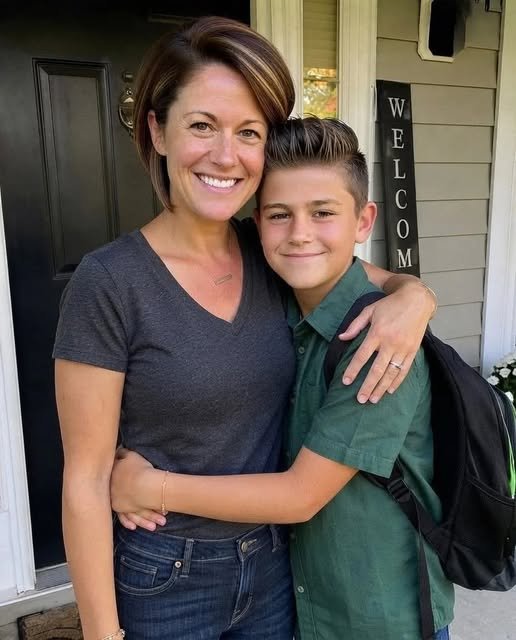
The next morning, Monday arrived with its usual frantic energy. Noah came bounding down the stairs wearing his crisp new sneakers and lugging the slightly oversized backpack he had spent nearly an hour choosing at the store.
He reached the front door, grabbed the handle, and suddenly stopped.
“Aren’t you forgetting something?” he asked, raising an eyebrow.
I looked around the entryway, puzzled. “Your lunch is already packed and in your backpack.”
“The picture, Mom. First day of seventh grade?”
I laughed out loud and quickly reached into my pocket for my phone. But before I could even open the camera app, Noah unzipped his backpack, pulled out his lunch bag, and peeked inside.
Tucked neatly between his sandwich and his apple was a bright yellow note.
Seventh grade. Please don’t become unbearable. Love, Mom.
He pulled it out, read it, and shot me a deeply offended, dramatic look.
“Seriously?”
“Extremely serious.”
Instead of rolling his eyes or tossing it on the counter, he folded the little yellow square carefully and slipped it securely into his front pocket.
Protecting your child doesn’t always mean shielding them; sometimes it means teaching them what isn’t theirs to carry.
Then he turned around and walked out toward the front porch. “Okay,” he said, squaring his shoulders. “Take the picture.”
I lifted my phone and snapped the photo. He stood there trying very, very hard not to smile, looking older and wiser than he had just a few days prior.
For years, I firmly believed that protecting Noah meant shielding him, building a wall to keep every ugly, complicated adult emotion far away from him.
But that exhausting, terrifying weekend taught me something profoundly different.
Sometimes, protecting your child doesn’t mean carrying every single burden yourself so they never have to see it. Sometimes, true protection means noticing when a burden has been unfairly placed in their hands—and having the courage to take it away and give it right back to the adults who created it.
Note:This work is inspired by real events and people, but it has been fictionalized for creative purposes. Names, characters, and details have been changed to protect privacy and enhance the narrative. Any resemblance to actual persons, living or dead, or actual events is purely coincidental and not intended by the author.
All images used in this article are AI-generated and intended for illustrative purposes only.