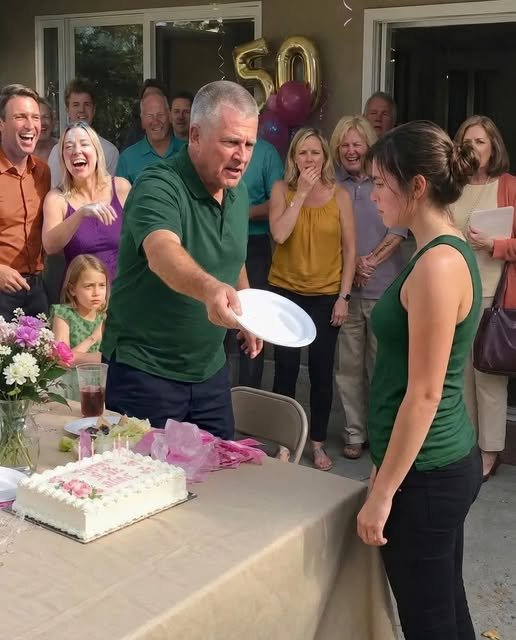
At my mother’s sixtieth birthday, my stepfather handed me a flimsy paper plate, looked me up and down, and announced to a room full of people, “The help eats outside.”
For half a heartbeat, nobody moved. The air in the room grew thick. Then, my cousin let out a loud snort of laughter. My stepbrother almost choked on his craft beer. I watched two neighbors turn away, desperately trying to hide their amused smiles.
And my mother? Linda stood right beside her towering birthday cake, perfectly manicured hands clutching a crystal glass, and said absolutely nothing.
I spent the entire morning setting up the perfect party, only to be treated like an unwelcome employee.
The Curse of Being “The Practical One”
I looked down at the cheap paper plate in my hands. I had spent the entire morning breaking my back to set up this party at our family’s beautiful lake house in Charlotte, North Carolina. I had hauled heavy wooden tables, rewired a broken string of patio lights, painstakingly arranged the centerpieces, and lugged trays of food from the caterer’s van. Why? Because Mom had called me in a panic at 7:12 a.m., crying that she was completely overwhelmed.
That has always been the problem with being the useful one in a toxic family. Eventually, your usefulness becomes your entire identity. They stop seeing you as a person and start seeing you as a utility.
My stepfather, Gary Mercer, had spent the last twelve years introducing me to his friends as “the practical one.” It was his polite, passive-aggressive way of saying I wasn’t impressive or wealthy enough for his standards. I proudly owned a successful commercial maintenance company with twenty-three employees. But because I still wore scuffed work boots and knew how to patch a leaking pipe with my own two hands, Gary treated me like the hired help brought in to clean up everyone else’s messes.
“Come on, Claire,” Gary said, gesturing dismissively toward the side gate. “Don’t make it awkward for everyone.”
The murmurs and light laughter started up again. I looked at my mother, waiting for her to step in. I waited for her to say, “Gary, stop it. She’s my daughter.” Instead, she just lowered her eyes to the floor.
Something deep inside my chest went completely, permanently quiet.
“Happy birthday, Mom,” I said softly.
I gently placed the paper plate on the gift table, picked up my purse, and turned to walk away. I was completely done.
The Arrival of Aunt Rebecca
I had my hand on the handle of the patio doors when a sharp, authoritative woman’s voice cut through the chatter of the room.
“So… nobody told them yet?”
Aunt Rebecca’s timing was impeccable, and the leather case she held contained a bombshell.
My Aunt Rebecca stood in the doorway, silhouetted by the afternoon sun, holding a thick leather document case. She was my mother’s older sister—a fierce, no-nonsense woman and the executor of my late Grandmother Rose’s estate. The estate had been bitterly stuck in probate for eighteen agonizing months because Gary had decided to challenge the will.
Every single face in the room turned toward her. The silence this time was deafening.
Rebecca looked at Mom first. Then she glared at Gary. Finally, her eyes landed on me, softening just a fraction.
“The judge signed the final order at 2:40 this afternoon,” she announced, her voice echoing in the quiet room. “Claire, the lake house and Rosewood Holdings are officially yours.”
Gary’s smug smile vanished instantly. My mother’s knuckles went white as she gripped the edge of the cake table.
For context, Rosewood Holdings was massive. It owned not just the gorgeous lake house we were standing in, but the five pristine acres surrounding it, plus a highly lucrative commercial property across town.
Gary’s face drained of color. “That’s impossible,” he stammered.
Rebecca didn’t blink. She slowly unzipped her leather case. “No, Gary,” she replied ice-cold. “What’s impossible is the sale contract you signed yesterday for property you never owned.”
The Million-Dollar Secret
Gary stared at Rebecca like she was speaking a foreign language. “What sale contract?” he choked out, playing dumb.
Rebecca calmly removed a thick, stapled packet of papers and slapped it down right beside Mom’s birthday cake. The details were glaringly clear.
The buyer was a massive firm called Northbridge Development. The purchase price was a staggering $1.46 million. The closing date was set for January 8th. The secret agreement included the lake house, the surrounding acreage, and the commercial building that Rosewood Holdings rented out to a wealthy medical practice.
Worse, Gary had already accepted a $75,000 cash deposit. He had also legally promised the buyer that the property would be delivered vacant.
My name, the actual owner, appeared nowhere on the preliminary documents.
The truth was out in the open, and Gary’s multi-million dollar house of cards was collapsing.
“You knew probate wasn’t finished,” Rebecca scolded him, her voice dripping with disgust.
Gary’s jaw tightened in defense. “Linda was Rose’s daughter! Everybody knew the property would automatically go to her.”
“No,” I finally spoke up, finding my voice. “Everybody assumed.”
Grandma Rose had secretly changed her will two years before she passed away. While Gary and my mother were busy living their lavish lifestyle, I had spent nearly every Saturday with Grandma during her final eighteen months. I drove her to doctor’s appointments, repaired her aging house, bought her groceries, and simply sat and listened when she needed company. I never once asked what she intended to leave me. I just loved her.
Gary, however, insisted I had manipulated her. He dragged the family through court, spreading malicious lies to our relatives that I was a gold-digger trying to steal my mother’s rightful inheritance. That toxic lie was exactly why half the people at this party felt comfortable treating me like garbage.
The Ultimate Betrayal
Rebecca opened another notarized document. Grandma had left Mom a very generous $180,000 in cash, along with lifetime income payments from a separate, secure investment account. But she left the real estate empire to me.
Why? Because, as Grandma wrote in her attached letter: “Claire protects what everyone else assumes will protect itself.”
My mother finally broke down, quietly sobbing into her hands. Gary didn’t even look at her; his eyes were glued to the doomed sale contract.
“Linda signed it too,” he threw her under the bus without hesitation.
The atmosphere shifted from shocked to downright toxic. I turned toward my mother. Her silence over the paper plate incident earlier suddenly felt incredibly small compared to the massive betrayal sitting on the cake table.
“Mom?” I asked, my voice cracking.
She wouldn’t meet my eyes. “He… he said the judge would rule for us,” she whispered.
Rebecca’s expression hardened into granite. “You signed a legal contract selling assets still controlled by a pending estate.”
Then Gary snapped. He slammed his hand on the table. “Fine! Claire can sign it now. She gets her stupid money. We all move on. Everyone wins.”
I let out a harsh, bitter laugh. “Let me get this straight. You illegally sold my grandmother’s home yesterday, publicly humiliated me in it today, and now you want me to give you my signature?”
“This family has carried you long enough!” Gary shouted, his face turning purple.
“No, Gary,” Rebecca interjected smoothly, reaching into her case one last time. “There’s one more glaring problem.” She placed a freshly printed bank record in front of him.
The $75,000 deposit from the developers had arrived on Monday. By Tuesday morning, $61,800 of it was already gone. It had been secretly wired to Mercer Performance Motors—the failing, bankrupt auto dealership owned entirely by Gary’s son.
Across the room, my stepbrother abruptly stopped laughing.
Rebecca looked at my mother with deep pity. “Linda,” she said quietly. “Tell Claire whose signature authorized that wire transfer.”
Mom’s lips trembled violently. She finally looked at me, tears streaming down her face. “Yours.”
The Fallout and the Fraud
I stared at the document. I didn’t recognize the signature at all. Oddly enough, that realization brought a wave of immense relief. I wasn’t crazy; I was the victim of a crime.
Rebecca explained the grim reality to the silent room. Northbridge’s corporate attorney had contacted her that very morning. Their title search flagged that Rosewood Holdings was still locked in Grandma’s estate. To bypass this, Gary had illegally fabricated a “board consent” form, claiming I had fully approved the sale and authorized the immediate release of the deposit funds.
He had meticulously traced my signature from an old maintenance contract my company had completed for Mom three years prior. Gary had then boldly signed beneath it, listing himself as the “Manager.” He had never worked a day for my company. And to make matters infinitely worse? My mother had signed the document as his official witness.
For the first time that entire afternoon, nobody was looking at me like I was “the help.”
Gary started backpedaling, talking a mile a minute. He babbled that the dealership desperately needed an emergency cash injection to stay afloat, that his son was going to repay it before closing, and that since the sale was going to happen anyway, nobody had really lost anything.
Rebecca just slowly zipped her document case closed. “You spent money from a multi-million dollar transaction you had absolutely no legal authority to make. You’re done, Gary.”
The Aftermath and Moving Forward
The extravagant birthday party ended less than twenty minutes later. The guests fled like the house was on fire.
Northbridge Development swiftly canceled the contract and aggressively demanded their deposit back. Because the money was already spent on a failing business, Gary was forced to sell off two of his prized collector cars and heavily borrow against his own retirement account just to repay the developers and avoid a massive civil suit.
But he didn’t escape the law. My company officially referred the forged consent document to the local police after our attorney confirmed the signature was entirely fraudulent. The criminal investigation dragged on for five stressful months.
In the end, Gary pleaded guilty to felony forgery and attempted property fraud. Because the buyer successfully recovered their funds, he had no prior criminal record, and he fully cooperated, the judge showed leniency. He received a lengthy probation, was ordered to pay full restitution for my legal expenses, and was assigned hundreds of hours of community service instead of prison time.
My mother, thankfully, was not criminally charged. Investigators found no hard evidence that she had physically created the forged signature, though she tearfully admitted she had signed the original sale agreement fully knowing probate was unresolved.
That heartbreaking admission changed our relationship far more than Gary’s crude insult ever could have. She had stood by and watched him tell me to eat outside because she was secretly hoping that once the court ruled in their favor, I would be too ashamed, too broken, or too desperate for her maternal approval to fight them.
I gave Gary exactly thirty days to pack up and vacate my lake house.
I gave Mom a harder choice. She could either pack up and move with him, or she could stay in the guest room for six months while she found a smaller place of her own. I told her there would be no rent, but there would also be absolutely no loans, no secret sale contracts, and no toxic family “agreements” involving my property ever again.
She chose to stay. Gary moved into a cramped apartment near his son’s struggling dealership.
Healing the Wounds
My mother and I lived under the same roof for four incredibly uncomfortable months. At first, we were strictly polite, tiptoeing around each other. Then, slowly, the walls broke down, and we became brutally honest.
One quiet evening, she sat at the kitchen island and finally said, “I should have defended you before I ever knew what Grandma left you.”
I looked at her across the granite counter. “Yes. You should have.”
That was the true apology I needed, because it named the real wound. It was never about the money; it was about the respect.
The lake house isn’t a trophy of my victory; it’s a sanctuary for those who truly care for their loved ones.
I didn’t keep the sprawling lake house as a spiteful trophy. The following spring, I sold the commercial building in town, kept the beautiful five acres, and poured my heart into renovating the main house. I turned it into a small, peaceful retreat center dedicated to families who are actively caring for elderly relatives.
Grandma Rose had spent her final years terrified that she was becoming a burden to her family. I wanted something genuinely useful, something healing, to come from the beautiful place she had worked so hard to protect.
Mom eventually moved into a nice, quiet condo about fifteen minutes away. We speak now, but carefully, building a new boundary-filled relationship. Gary and I do not speak at all.
At my next birthday, Aunt Rebecca arrived at my door with a bag of expensive takeout food and two flimsy paper plates. She handed one to me, her eyes twinkling as she raised a perfectly arched eyebrow.
“Inside or outside?” she deadpanned.
I laughed harder than I had in years. Then, I carried both of our paper plates to Grandma’s old kitchen table, right in the heart of the house.
The year prior, my family had laughed at me because they honestly believed that being useful, getting my hands dirty, and caring for others made me small. They learned, far too late, that I had never been the help.
I was the foundation. I was the person holding everything together. And now, I own the ground they used to walk on.
Note:This work is inspired by real events and people, but it has been fictionalized for creative purposes. Names, characters, and details have been changed to protect privacy and enhance the narrative. Any resemblance to actual persons, living or dead, or actual events is purely coincidental and not intended by the author.
All images used in this article are AI-generated and intended for illustrative purposes only.