I lied to my register so a broke girl could buy her prom dress, and what she said next broke me clean open.
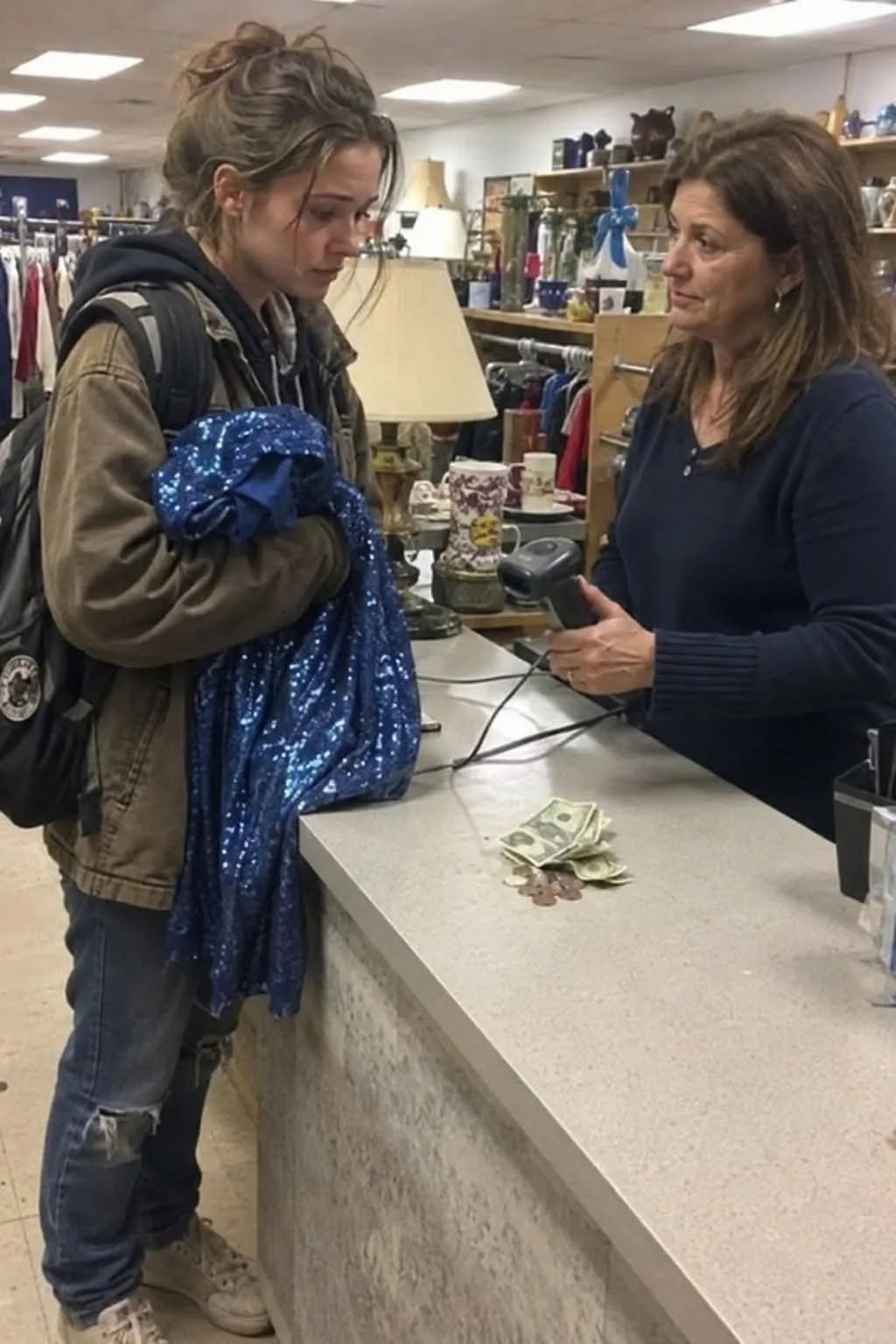
She stood at my counter with a blue sequined dress folded carefully over her arms, holding it like it was something fragile and alive. It wasn’t that flashy, fancy-rich kind of blue. It was a deep, vibrant shade of hope blue. The handwritten price tag dangling from the zipper read $25.
Without a word, she emptied her fist onto the scratched glass of the jewelry counter. Crumpled one-dollar bills flattened by nervous hands. Two faded five-dollar bills. A little pile of loose quarters she had been carrying tucked deep into her worn jacket pocket. She counted the money once. Then, she counted it again, her shoulders sinking.
Then she looked up and gave me that specific, heavy look people get when life has taught them not to ask for mercy.
“I only have fourteen,” she said quietly, her voice barely carrying over the hum of the store’s old boiler. “It’s okay. I can put it back.”
She tried to smile when she said it. That was genuinely the worst part. She wasn’t angry. She wasn’t dramatic or crying. She was just deeply, quietly embarrassed. It was the look of someone for whom disappointment was a routine she already knew by heart.
Counting quarters for a moment of magic.
I looked at the shimmering blue dress. Then I looked down at her sneakers, worn thin and scuffed white at the toes. Her faded backpack bore a sewn-on school patch from the public high school just down the road. She couldn’t have been more than seventeen years old.
“Hang on,” I said, lifting my hand.
I picked up my handheld barcode scanner, aimed it directly at the $25 tag, and made a little theatrical show of squinting at the digital register screen. “Oh,” I said, feigning surprise. “Well, would you look at that. Blue tag clearance. It just dropped to ten dollars.”
Her whole face changed. It wasn’t just happiness. It was pure, unfiltered relief. It looked exactly like somebody had reached into deep water and pulled her up for a breath of air. “Really?” she breathed.
“Really.”
Her hands visibly started shaking as she pushed the crumpled bills toward me across the glass. She kept whispering, “Are you serious? Are you serious?” like if she stopped asking, the fragile dream might simply evaporate.
I rang it up. Ten dollars. I handed her the four dollars in change.
She hugged that blue dress to her chest so tightly I genuinely thought she might cry right there at the register. Then she looked up at me, her eyes shining, and said, “My mom thought I wasn’t going to go.”
I smiled softly and asked, “Prom?”
She nodded. But she didn’t move toward the door. Sometimes, people desperately want to say one more thing, and you can feel the weight of it before they even open their mouths.
“She used to love dances,” the girl said. “Before she got sick.”
I stayed entirely quiet, letting her hold the space.
“My mom’s been in a hospital bed in our living room since January. We had to sell a lot of stuff to keep up. I’ve been helping after school and working weekends at a diner. I was saving for this dress a dollar at a time.” Her voice grew smaller, more fragile. “I know prom is stupid when bills are what they are. But she kept saying she wanted to see me dressed up just once. She said I should have one normal night.”
I swear my throat closed completely. Because in that moment, it wasn’t about sequins anymore. It wasn’t about a high school prom. It was about a bone-tired teenage girl trying to give her mother one small, beautiful thing before life took away another.
She thanked me three separate times before she left. At the door, she turned back and said, “You made my mom’s week.”
Then she was gone out into the cold. Just a kid in a secondhand coat, carrying a clearance dress like it was worth a million dollars.
That night, when I counted the register to close out my shift, it was short fifteen dollars. I knew it would be. I calmly took out my own wallet, pulled out a ten and a five, and covered the drawer. It was the best fifteen dollars I ever spent. I thought that was the absolute end of it.
It wasn’t.
The Photograph That Changed Everything
Three days later, right before the store was about to close, she came back in. Her hair was done up beautifully. Her makeup was simple and elegant. And she had the blue dress on. She looked breathtaking, but not in the hollow, magazine way people usually mean. She looked incredibly proud.
She had a smartphone in her hand.
“My mom wanted me to show you this,” she said.
It was a photo of her standing beside a medical hospital bed set up right in the middle of a living room, wearing our blue dress. Her mother looked pale, thin, and fragile, but she was smiling so hard and with so much radiant joy that it nearly undid me. On the blanket draped across her lap was a handwritten sign, scrawled in thick black marker:
SHE SAID YES TO PROM.
One normal night, frozen in time forever.
I laughed and cried at the exact same time, standing right there by the racks of used lamps and chipped coffee mugs. The girl took a shaky breath and told me her mom had passed away the very next morning. Prom was that night.
“She told me I still had to go,” she whispered. “She said no daughter of hers was staying home to mourn in a pretty dress.” Then she smiled through thick tears and added, “She also said whoever sold it to me was an angel with a barcode scanner.”
I am not an angel. I’m just a woman who runs the front end of a thrift store in a town where far too many kids are forced to grow up way too fast.
But I’ll tell you this with utter certainty: Sometimes the kindest thing you can do is break a tiny rule in a world that keeps breaking people.
The Price of Kindness
What I did not know, standing there with my hand still resting on the counter after she left, was this: My fifteen dollars was about to become everybody’s business. Not because it was a lot of money, but because it was the kind of money people use to decide exactly who they are.
I locked up that night with her mother’s words still ringing loudly in my ears. An angel with a barcode scanner. I am not built to carry a heavy sentence like that lightly. The store smelled like old paper, laundry soap, and dust-warmed wood, same as always. But it did not feel the same. Nothing did.
When the dark settled in the store, I thought maybe that was it. Maybe some stories just arrive, break your heart open, and leave. At the door, I realized I still did not know her name. I did not even know her mother’s. That sat terribly wrong with me.
The next morning, before I even poured my first cup of coffee, I unlocked the store feeling heavier than I should have. I was halfway through sorting a bag of donated shoes when Dottie came rushing in from the back. Dottie was a tough woman who didn’t startle easy. But that morning she looked at me like I had caught fire and hadn’t noticed yet.
“You need to see this,” she said, holding out her phone.
On the bright screen was the girl. The blue dress. The hospital bed. Her mother smiling. The same sign. But underneath it was a viral caption from a local town gossip page:
Her mother died the morning after this photo. She still went to prom because it was her mother’s last wish. A thrift-store cashier secretly made the dress affordable. Sometimes one act of kindness changes everything.
Below that were thousands of comments. Prayers. Hearts. People calling whoever sold her the dress a saint. But then came the colder ones—the ones dressed in stiff logic.
“Kindness is beautiful, but employees can’t just make up prices.”
“If the shop supports local families, she stole from other needy people.”
“This is why small stores can’t survive.”
I stared at the screen. What got me wasn’t the arguing; it was how fast the story had stopped belonging to the grieving girl who actually lived it. A mother dies, a daughter keeps a sacred promise, and by morning, strangers are using the blue dress to audition their own moral values.
The problem was that the worst comments weren’t entirely wrong. Front Porch was not just a thrift store. A portion of every sale went into the town’s pantry fund and covered emergency hotel nights for the homeless. I had made a rogue decision with money that had other vital claims on it. I knew that. But I also knew a tired seventeen-year-old had stood in front of me with fourteen dollars and the kind of quiet dignity that makes you ashamed of every comfortable thing you ever took for granted.
The Suspension
By ten-thirty, Edwin Lark, the store director, had seen the post. By ten-forty, he gently asked me into his office and closed the door. He held the printed inventory sheet. No markdown entered. No clearance adjustment.
“Claire,” he said, looking tired. “I need you to tell me exactly what happened.”
I could have lied. I could have blamed a tag switch or a register glitch. But I was not about to become a person who kept saving herself with another lie. So I told him all of it. The fake clearance, the hospital bed, the mother’s wish. I told him I covered the drawer out of my own pocket.
When I was done, Edwin rubbed a hand over his face. “I understand why you did it,” he said softly, which somehow made it worse. “But you cannot decide unilaterally where hardship funds go. You cannot turn inventory into private charity. We have policies for a reason.”
“She had enough choice already,” I argued. “The kind where every option costs you.”
Edwin exhaled a long breath. “The board will ask for a formal review. Until then, I need to suspend you.”
Just like that, my life tilted. I signed the administrative notice and packed my bag. By five o’clock, I was sitting on my couch, still wearing my work apron, staring at the wall.
Around six, my phone buzzed. It was a number I didn’t recognize.
“Hi,” a thin, shaky voice said. “This is Ava.”
For a second, relief and deep sorrow hit me simultaneously. She finally had a name. Ava.
“I’m sorry,” I said instantly.
“Did you get in trouble?” she asked, skipping any gentle openings. “I saw people guessing online. I didn’t write the part about the dress, a mom on the page did. I can’t be the reason you lose your job. Can I come by?”
Twenty minutes later, Ava stood in my doorway in the same secondhand coat. She held a bent paper envelope tightly in her hands and placed it on my kitchen table like it was hard evidence. Inside were crumpled bills and a roll of quarters. Thirty-one dollars.
“My tips,” she said fiercely. “I’m not going to let you get punished.”
I pushed the money back. “A choice is a cause, Ava. I made one. I don’t feel sorry for you. I feel furious for you.”
We sat in my kitchen as the evening dropped. Ava told me about her mother, Marlene, a woman who hated pity and performative charity. By the time she left, we had cried, laughed, and I had promised to attend Marlene’s funeral service that Thursday.
A Funeral and a Letter
The community chapel on River Street was small, with mismatched chairs and terrible coffee. A room built for people who cannot afford spectacle and don’t need it anyway. At the front, right in the middle of the memorial photos, was the prom picture. The blue dress. The hospital bed. The sign.
After the beautiful, simple service, Ava handed me a folded piece of notebook paper. “She wrote this when hospice came,” Ava said. “My aunt found it. It says your name on top.”
The handwriting leaned uphill, determined and fierce:
Claire,
Ava told me what you did. Most kindness comes with witnesses these days. Yours didn’t. Thank you for that. I have spent months watching my daughter become responsible in all the wrong ways. You gave her one night where she got to be exactly as young as she is. If anyone tells you it was only a dress, they have never had illness move into the living room and start eating the furniture.
Love, Marlene
I could barely see through my tears. When I looked up, Edwin Lark was standing there holding his hat. “The board meets tomorrow evening,” he told me quietly. “I’m trying to defend the possibility that a good person can do the wrong thing for the right reason.”
The Board Meeting
The meeting the next evening was packed. Nearly forty people—volunteers, teachers, customers—sat in folding chairs under the harsh fluorescent lights of the community room. The debate was fierce. Some argued for the sanctity of the rules and the pantry funds. Others argued for humanity and grace.
When they called my name, I stood up on shaking knees. “If all we ever think poor families deserve is survival, then we have quietly decided dignity is a luxury item,” I told the room. “Fire me if you need to. But if this store can build a formal way to protect moments like that without forcing kids to make a public case for why they deserve one beautiful thing, then maybe this mess can still become useful.”
Then, a man in the back stood up. “With respect, where’s the line? A prom dress today, a suit tomorrow. Everybody has a sob story.”
The room went icy sharp. And then Ava stood up from the back row, wearing a simple black funeral dress.
“My mother is dead,” Ava said, her voice cutting through the room without a microphone. She glared at the man. “Please don’t call that a sob story. To answer your question, the line is respect.”
The room froze completely. Ava walked right up to the board’s table and placed the bent envelope of tip money down.
Thirty-one dollars to buy back her dignity.
“This is thirty-one dollars,” she said fiercely. “Fifteen for the dress, and sixteen because everything costs more after a person dies. Maybe use the extra for whatever person doesn’t have a pretty story. And for the record, Claire did not make me feel poor. She made me feel normal. That’s different.”
The board deliberated. When they returned, they upheld my policy violation and fired me effective immediately. But then, they read the second half of the decision.
They voted to establish a pilot program for discretionary milestone assistance—proms, interviews, graduations—called the Marlene Fund. No public applications. No humiliation. Just quiet help through community referrals.
I had lost my job, but a new door had been kicked wide open. Outside in the cold parking lot, Edwin handed me my final paycheck. “The Marlene Fund needs a volunteer coordinator,” he said, looking away into the night. “Unpaid at first. I said I couldn’t trust you with unilateral pricing. I did not say I doubted your ability to build something better.”
One Normal Night
Three days later, Ava came to my apartment with the blue dress in a garment bag. She didn’t want to sell it. “I want it to keep saying yes,” she told me. “I’m asking if you want to help me build a closet for the girls who put beauty back on the rack first.”
And so we did. We called it One Normal Night. We started in the back room of a local diner, offering donated formal wear with quiet dignity. No savior complexes. No social media before-and-after photos. Just clothes, and a little dignity with a zipper.
By spring, we had our own storefront. Inside, we sewed special tags into the collars of the beautiful clothes. They didn’t have prices. They just had three simple words.
The only price that matters.
When a nervous teenager would try on a silver dress, stare in the mirror, and nervously ask how much it cost, Ava would reach over, flip the tag, and show them the words: Already Covered.
“It means,” Ava would say with a soft smile, “today you just worry about whether you can dance in it.”
Do I regret breaking the rules? No. The cashier was wrong, and the cashier was right. The money mattered, and the moment mattered, too. A dress is just a piece of fabric—until it is the last photograph beside a hospital bed, and the last promise a dying mother gets to keep.
I lied to my register so a broke girl could buy her prom dress. That part is entirely true. But the end of the truth is this: She came back with grief in one hand and fierce dignity in the other, and together, we built a place where the next kid would never have to choose between them.
Note:This work is inspired by real events and people, but it has been fictionalized for creative purposes. Names, characters, and details have been changed to protect privacy and enhance the narrative. Any resemblance to actual persons, living or dead, or actual events is purely coincidental and not intended by the author.
All images used in this article are AI-generated and intended for illustrative purposes only.