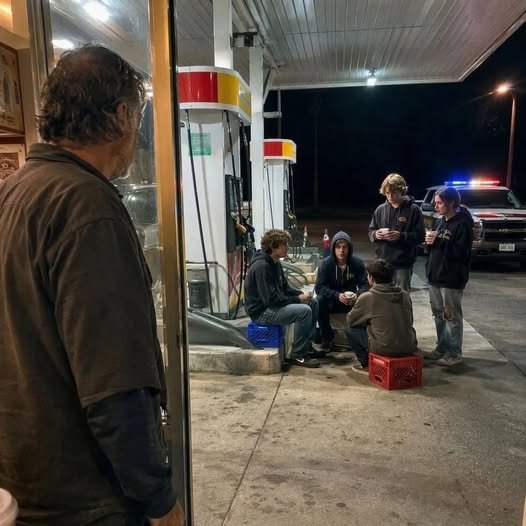
“Those kids are going to scare off the customers.”
I was slowly wiping sticky, brown coffee rings from the faded laminate counter when Deputy Harris nodded his chin toward the front windows. Outside, the world was swallowed by the vast, ink-black New Mexico night, save for the flickering, buzzing fluorescent lights of our isolated two-lane highway gas station.
Under the glow of pump six stood five teenagers. Their hoodies were pulled tight against the biting desert wind. One of them leaned casually against the rusty tailgate of an old pickup truck. Another sat cross-legged on the cold concrete curb, cradling a steaming paper cup between both hands like it was a small campfire.
“They haven’t bothered anybody,” I said, keeping my eyes on my rag.
The deputy gave me a heavy sigh and that knowing, sympathetic look adults often give when they believe another adult is being dangerously naive. “Not yet,” he muttered, adjusting his belt before walking out the glass double doors.
To the rest of the world, they were just kids looking for trouble. To me, they were just looking for a light.
When Life Strays from the Blueprint
My name is Nolan. I was fifty-seven years old and working the lonely midnight-to-sunrise shift pouring bad coffee for strangers. It wasn’t because I loved the nocturnal life, but because life had violently veered off the track I had so carefully laid out.
Just two years earlier, the bank had foreclosed on the modest little house my wife and I had spent twenty-three years dutifully paying off. I lost her to a long illness before I lost the house. Between the crushing avalanche of medical bills, missed mortgage payments, and a dark emotional stretch I just couldn’t seem to climb out of, the place with our children’s height measurements penciled onto the kitchen doorway suddenly belonged to somebody else.
Left with nothing but memories, I rented a cramped, one-bedroom apartment above an old hardware store in town. I took the night shift because the quiet helped, and the darkness felt fitting.
But you learn profound things on the night shift. You become an observer of humanity’s quietest hours. You learn which long-haul trucker calls his wife every single night at 1:15 a.m. sharp. You learn which exhausted ICU nurse buys two breakfast sandwiches after her grueling twelve-hour shift—one for herself, and one for the husband waiting patiently at home. Most importantly, you learn that loneliness wears a different mask on everybody.
And I quickly learned that a group of teenagers hanging around a brightly lit gas station at 1:00 in the morning aren’t always looking to cause trouble. Sometimes, they are simply looking for a place where the lights are still on.
The Seventy-Five Cent Hot Chocolate
The first kid I really got to know was a seventeen-year-old named Marcus. He wandered in one freezing January night, shivering in his thin black hoodie. He walked up to the counter, placed three quarters on the glass, and asked how much a hot chocolate cost.
“Dollar seventy-nine,” I told him gently.
Marcus stared at the dull silver coins in his palm for a long moment. His shoulders slumped, and he quietly started sliding the money back into his pocket to leave.
“Hold on. Machine’s acting up tonight,” I said loudly, tapping the side of the register.
He looked at me, confusion knitting his brow. “What?”
“It’s only charging seventy-five cents tonight.”
He knew I was lying. I knew he knew. But a faint, grateful smile touched his lips, and he slid the coins across the counter anyway.
Sometimes a small lie is the kindest truth you can offer someone in need.
After that night, Marcus became a regular. He came in most nights around midnight, and soon, he started bringing friends. There was Jenna, a bright-eyed girl who carried a heavy, book-stuffed backpack absolutely everywhere. There was Luis, a kid who laughed a little too loudly whenever he felt anxious or out of place. And there was Caleb, a quiet, broad-shouldered boy who wore the same faded, grease-stained canvas work jacket every single night.
They weren’t perfect angels by any stretch. They cursed when they got excited. They left crumpled straw wrappers on my pristine counter. They passionately argued about hip-hop artists and slammed car doors much harder than necessary. In short, they were teenagers.
But piece by piece, I learned the real reasons they congregated on my curb.
- Marcus waited at the station because his mother cleaned rooms at a motel fifteen miles away and didn’t get off shift until after midnight. The trailer park where they lived was too dark and too far to walk to safely.
- Jenna’s father worked the graveyard shift at a local food-processing plant. Her little brother stayed with a neighbor, and she simply couldn’t stomach the thought of going home to an empty, echoing house.
- Luis never elaborated much on his home life. He only told me once, in a voice barely above a whisper, “It’s calmer here.” That was all I needed to know.
So, I established a ground rule. “You kids can stay,” I announced one night, leaning over the counter. “But you keep the lot spotless, you don’t ever bother the paying customers, and if anybody needs help carrying something to their car, you jump up and help.”
Marcus grinned, a spark of mischief in his eye. “What do we get out of this deal?”
I pointed at the bubbling coffee machine. “Coffee after midnight is free.”
Jenna scrunched her nose in disgust. “Gross. We’re seventeen, Nolan.”
I shifted my finger toward the cocoa dispenser. “That too.”
They laughed, and a pact was formed. From then on, every night, somebody was out there sweeping up candy wrappers or carrying heavy jugs of windshield wiper fluid for elderly drivers. Through the glass, I’d watch six or seven kids sitting on the curb, sharing steaming paper cups. They talked about their agonizing homework, their dead-end after-school jobs, cheap cars, and their grand plans to leave this small town someday.
Still, society judged them. Truckers would stomp in, glance out the window, and ask, “Those kids giving you any trouble?” Deputies continued to slow their cruisers to a crawl through the lot, shining their spotlights. One older customer even locked her doors and refused to get out of her car until I walked outside to escort her.
I understood the wariness. A pack of teenagers lingering after midnight can look threatening when you don’t know their names or their stories. But names have a funny way of changing your perspective. Marcus wasn’t “that scary kid in the black hoodie”; he was a dedicated son saving every penny for community college. Jenna wasn’t “the girl loitering at 1:00 a.m.”; she was a straight-A student seeking safety. Caleb wasn’t suspicious; he was just dead on his feet tired.
The Night Everything Almost Ended
Everything nearly came crashing down one Thursday night in early spring.
I was in the back stockroom organizing boxes of motor oil when I heard the sickening crunch of metal smashing against metal. My heart leaped into my throat, and I sprinted outside.
Two older young men I had never seen before were tearing through our lot in a beat-up, roaring sedan. One had kicked over our heavy steel trash can, sending garbage flying across the asphalt. The other was shaking a spray paint can, quickly tagging the side wall of the building.
By the time I pushed through the front door, the situation had already escalated. But it wasn’t me intervening. Marcus and Luis were standing their ground, shouting fiercely at the men to get out of their lot. Jenna was already on her phone, giving the dispatcher our address. Caleb had run forward, physically dragging the remaining trash cans out of the sedan’s destructive path.
Realizing they were outnumbered and the cops were on the way, the vandals peeled out, tires squealing into the night.
The next morning, my boss, Mr. Henderson, arrived. He was furious. He stared at the ugly graffiti on the bricks. He stared at the dented trash cans. Then, his eyes narrowed as he looked at Marcus, Jenna, and the others, who had stayed late and were sitting quietly near the curb, looking exhausted.
“That’s it,” Mr. Henderson snapped, turning to me. “Those kids are done hanging around here. Run them off.”
“They didn’t do this,” I told him firmly, stepping between him and the window.
He crossed his arms, his face flushed. “Nolan, come on.”
That sentence—come on—bothered me deeply. He said it as if the answer was incredibly obvious. As if wearing a hoodie was empirical evidence of a crime. As if simply existing somewhere late at night made a kid inherently guilty.
“We have cameras,” I said, my voice steady. “Let’s look.”
The truth is often hidden in plain sight, waiting for someone willing to watch.
We went into the cramped back office and rolled the tape. The grainy black-and-white footage showed everything in undeniable detail. The erratic sedan pulling in. The strange men getting out. The sudden, chaotic vandalism.
And then, the footage showed Marcus bravely stepping forward into danger. It showed Luis aggressively waving them off. It showed Jenna calling for help, and Caleb risking his own safety to protect the station’s property. The vandals hadn’t left because they were finished; they left because the very teenagers everybody feared had fiercely protected the place.
My boss watched the footage in absolute silence. Then he rewound it and watched it a second time. He leaned back in his squeaky leather office chair, rubbing his jaw.
“Well,” he said softly, the anger completely drained from his voice. “I guess I had that entirely wrong.”
That night, around 12:30 a.m., the kids were sitting outside. Mr. Henderson walked out the front doors carrying a large, heavy cardboard box. The kids instantly went dead quiet, tensing up, expecting to be kicked off the property forever.
Instead, he set the box down heavily on the curb right in front of them and walked back to his car without a word. Inside the box were stacks of premium paper cups, a giant bag of mini marshmallows, a bulk box of rich cocoa packets, and a handwritten cardboard sign that read: AFTER MIDNIGHT — FREE.
Marcus looked through the glass window at me, his eyes wide. I just smiled and shrugged my shoulders. He smiled back. It wasn’t the guarded, sarcastic teenage smirk he usually wore. It was a real, bright smile—the kind that makes you realize they are still, in many ways, just children.
What Makes a Home
Life, as it always does, moved on. Winter thawed into a warm, breezy spring. The dynamic of our midnight crew shifted as the kids grew up. Marcus landed a solid apprenticeship at a local auto shop and didn’t need to wait for his mom anymore. Jenna proudly graduated with honors. Luis started working early morning shifts at a diner and constantly complained to me that “morning people are highly unnatural.”
I missed them, but I was proud of them.
Then, one quiet Tuesday afternoon, my landlord called me at my apartment.
“Hey Nolan, just calling to let you know your rent’s covered,” he said casually.
I rubbed my eyes, thinking I had misunderstood him through the static. “You mean for this month? I haven’t dropped the check off yet.”
“No, Nolan. For three months. It’s paid in full.”
I slowly sat down on the edge of my mattress, my heart pounding. “By who?”
“They explicitly asked me not to say.”
That evening, as I was leaving for my shift, I found a plain white envelope taped securely to my apartment door. I tore it open. Inside was a single, folded sheet of lined notebook paper. The handwriting changed halfway down the page, looping and slanting in different directions, making it clear that several different people had taken turns writing it.
It read:
“You were the very first grown-up who didn’t decide we were trouble before taking the time to ask why we were here. You gave us somewhere warm to sit when we really needed it. We know things haven’t been easy for you lately either. So this one’s on us.”
At the bottom of the page, scrawled in different colored inks, were seven first names.
The greatest investments we make in life rarely involve money.
I stood frozen in that narrow, drafty hallway holding the note for a very long time, tears finally spilling over my eyelashes. I had lost a house. I had lost the beautiful wooden porch where my wife used to sit and drink her morning coffee. I had lost the warm, bustling kitchen where my children grew up.
For years, I had carried a heavy stone in my chest, convinced that losing that physical home meant I had failed as a man, a husband, and a father.
But a group of misunderstood teenagers taught me something at fifty-seven years old that I probably should have understood much earlier in life.
A home is not always four solid walls with your name signed on a thirty-year mortgage. Sometimes, a home is a brightly lit gas station at 1:30 in the morning. Sometimes, it is the hum of cheap fluorescent lights, the smell of burnt coffee, and a grieving, tired grown man who simply looks at you and says, “You can stay.”
And sometimes, the people the world is the quickest to judge, dismiss, and push away are the very ones who remember a simple act of kindness the longest.
I still work the night shifts. The hot chocolate and coffee are still free after midnight. And whenever I see a young person standing alone out there beneath those buzzing neon lights, I always try to remember this one truth:
Before you decide someone is trouble, ask yourself whether they might just be looking for somewhere safe to belong.
Note:This work is inspired by real events and people, but it has been fictionalized for creative purposes. Names, characters, and details have been changed to protect privacy and enhance the narrative. Any resemblance to actual persons, living or dead, or actual events is purely coincidental and not intended by the author.
All images used in this article are AI-generated and intended for illustrative purposes only.