The whispering stopped the moment my hand touched my seven-year-old son’s bedroom door.
Bennett stood behind me, gripping my coat with trembling fingers.
“Please don’t go in,” he whispered. “They told me you’d be angry.”
I had returned home early from a four-day work trip after my final meeting was canceled. I had even changed my $380 flight because I couldn’t wait to see my son.
I expected Bennett to run into my arms.
Instead, the house was strangely quiet.
My sister Lauren’s car was parked in the driveway, and two untouched mugs sat beside the kitchen sink. Lauren was 32 and had rearranged her entire schedule to watch Bennett while I was away. She would never have left him alone without telling me.
Then I heard something from behind Bennett’s bedroom door.
A strip of light glowed underneath it.
Then came the unmistakable scrape of something heavy being dragged across the floor.
I looked at Bennett.
His fingers tightened around my coat.
When I opened the door, I froze.
Lauren was crouched beside the bed.
And standing beside an open cardboard box was my father—the man I hadn’t seen in eight years.
For several seconds, nobody said a word.
My father had changed. His hair was almost completely gray, and his shoulders seemed smaller than I remembered.
Lauren had moved Bennett’s toy chest away from the wall.
Before I could demand an explanation, Dad removed a loose piece of wooden trim and reached into a narrow opening hidden behind it.
He pulled out a small metal tin wrapped in an old kitchen towel.
I recognized it immediately.
It was my mother’s recipe box.
My mother had died when I was 19 after nearly a year of illness.
My father had disappeared during her final months, saying he couldn’t bear to watch her decline.
Lauren and I stayed.
We cared for our mother, arranged her funeral, and tried to rebuild our lives afterward.
For years, we wondered how our father could simply walk away.
But when Dad opened the tin, there were no recipes inside.
There were dozens of sealed letters.
Every one was addressed to Lauren and me.
Each envelope carried a date from my mother’s final months. The handwriting was unmistakably hers.
There was also a note from her estate attorney explaining why the letters had been hidden.
My mother had apparently placed the box somewhere safe before renovations connected to the house’s mortgage, afraid the letters might otherwise disappear.
There was no secret investment.
No forgotten insurance money.
No court dispute.
No valuable inheritance.
Just words.
Words my mother had wanted her daughters to have.
My father finally admitted that she had asked him to deliver the letters when we were ready.
But he hadn’t.
Shame had kept him away year after year.
Then Lauren told me why he had finally come back.
Dad was seriously ill.
His doctors had told him he might have only six months left.
He apologized, but he didn’t ask me to forgive him.
He simply admitted that leaving had been selfish.
No explanation, he said, could bring back the birthdays, holidays, conversations, and ordinary family moments he had missed.
Bennett had been quietly watching him.
Finally, he asked the question only a seven-year-old could ask so simply.
“Is he my grandfather?”
My father lowered his eyes.
“Yes,” he said softly. “And I made a terrible mistake.”
I sat on the floor and opened the first letter with shaking hands.
My mother’s words were gentle.
She wrote that anger could protect you for a while, but eventually it could become a locked room. A room that keeps out not only the people who hurt you, but also the comfort that might still find its way inside.
Her words didn’t erase what my father had done.
They didn’t suddenly make eight years disappear.
And I didn’t forgive him simply because he was running out of time.
But I did something I hadn’t expected to do.
I let him stay for dinner.
Bennett sat across from him and began asking questions.
Did he like cereal?
Had he ever seen a bear?
What was his favorite subject in school?
Within minutes, Bennett had moved on to an endless list of questions that only a curious child could invent.
My father answered every one.
At the front door that evening, Dad hesitated.
“Could I call tomorrow morning?” he asked.
I agreed.
But I gave him one condition.
He could not make Bennett promises he wasn’t certain he could keep.
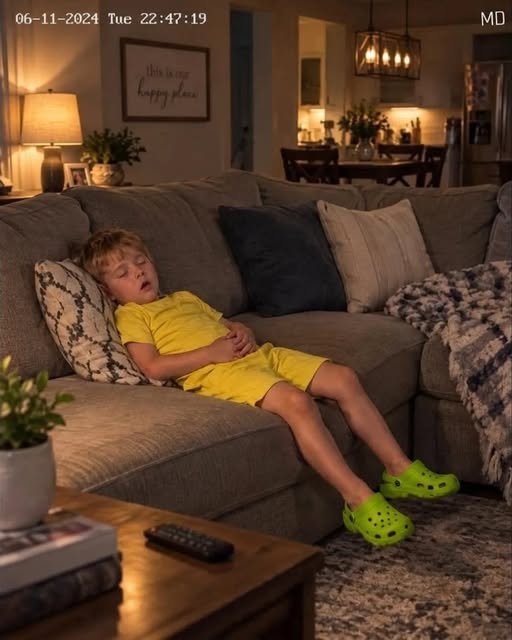
That night, Lauren and I sat together and opened another letter while Bennett rested nearby.
For almost twenty years, the wall in that bedroom had hidden our mother’s final words.
I had come home expecting a joyful reunion with my son.
Instead, I found something far more complicated.
A painful truth.
An unfinished apology.
And a family that, despite everything, might still have a small piece left worth saving.